
NFSA Amendment Explained: A Policy Shift, Or The Latest Layer Of A Longer Digital Exclusion?
The proposed NFSA amendment is the first major change on paper—but critics say it formalises a deeper shift already underway, where access to food is increasingly being shaped, and often restricted, by digitised welfare delivery.
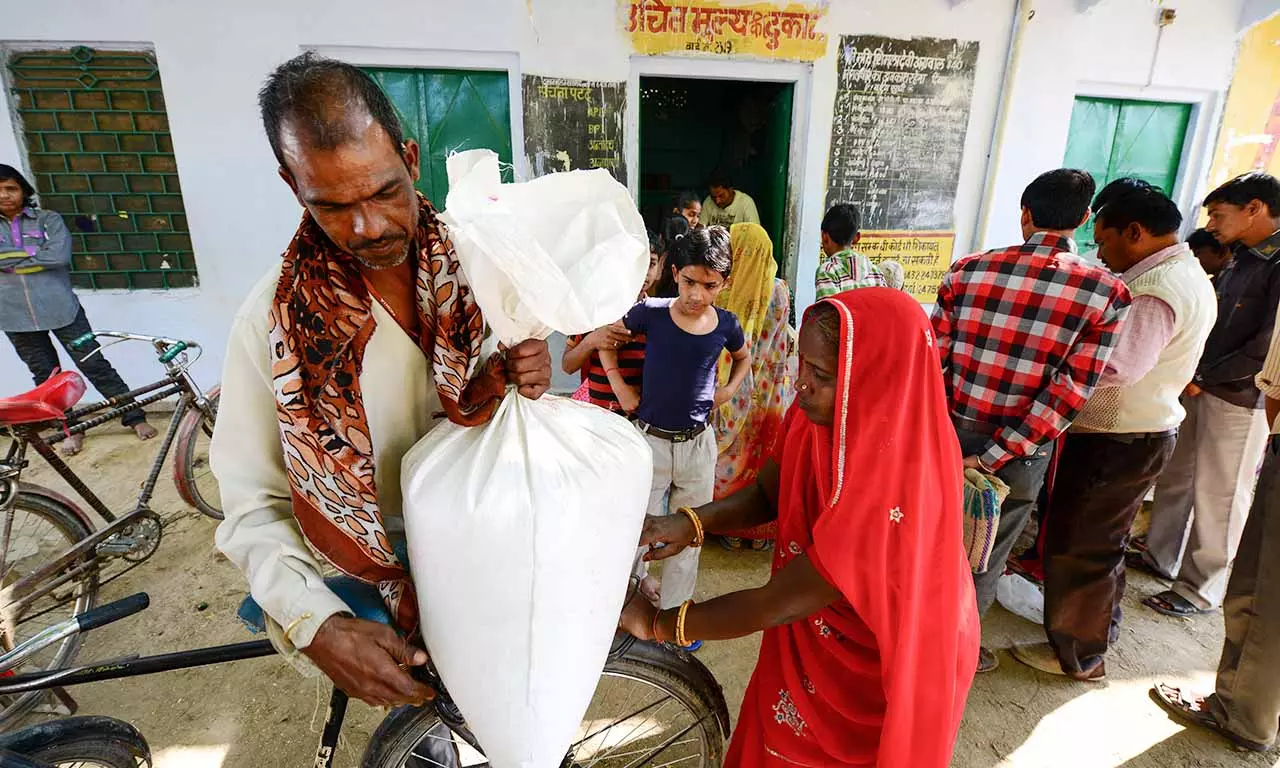
A single number is at the center of a fight over how India feeds its poorest households. The Union Food and Public Distribution Department wants to cap grain entitlements under the Antyodaya Anna Yojana (AAY) at 7 kg per person — replacing a flat 35 kg per household that has been held since 2013. On paper, it reads like a technical fix. Critics say it's something else: the formal codification of an exclusion that digitised welfare delivery has been quietly engineering for years.
The Union Food and Public Distribution Department released a draft amendment to the National Food Security Act (NFSA), 2013, in June. It was open for public comment until July 13.
With this amendment, India's food security law may be heading toward a major structural change on paper. But critics argue the real transformation has already been underway for years — quietly, through technology, data systems, and administrative redesign that have steadily reshaped who can actually access welfare.
The question the amendment forces into the open: has access to food already been narrowed long before anyone put pen to this draft?
What is changing under the draft amendment?
Under the current NFSA, households classified under the Antyodaya Anna Yojana (AAY)—the “poorest of the poor”—receive a fixed 35 kg of food grain per family per month, regardless of family size.
The proposed amendment shifts this to a per-person entitlement of 7 kg per month, but introduces a cap of 35 kg per household. This means that even larger families will not receive more than 35 kg in total.
The government noted that this change is meant to “rationalise” distribution and correct inconsistencies within the AAY category, especially where smaller households may receive disproportionately higher per capita benefits.
Critics say the amendment is less about correction and more about formalising a shift in how welfare is already being structured—incrementally, through systems rather than law.
Why are critics concerned about the cap?
Economists and activists argue that the redesign undermines the original intent of AAY as a protective category for the most vulnerable households.
Economist Jean Drèze noted that while a per capita model was discussed during NFSA's design, AAY was deliberately kept as a household-based entitlement to ensure that small, destitute families were not disadvantaged.
He argued there is “no strong reason” to reverse that design now, especially when it was meant as a safeguard against exclusion.
Dipa Sinha, a development economist actively involved with the Right to Food Campaign, raised concerns about both the 7 kg benchmark and the 35 kg cap, pointing out that the government has not clearly justified the underlying assumptions.
“If household size variation is the issue, it should be addressed through updated data—not a blanket cap.”
Importantly, she situated this within a broader pattern, “We are already seeing exclusion happening through systems. This is just another layer being added on top.”
Does the 7 kg figure make sense?
The proposed 7 kg monthly entitlement aligns closely with the Indian Council of Medical Research’s (ICMR) revised guideline of 250 grams of cereals per adult per day. Earlier, ICMR recommended 33-400 grams of cereals per adult per day which was about 9–12 kg per month.
However, experts caution against treating this as a complete nutritional benchmark.
ICMR’s updated recommendations are part of a broader shift toward dietary diversity, reducing dependence on cereals and increasing intake of pulses, proteins, fats, and fresh foods.
But that shift assumes households can actually afford the diversity, Sinha pointed out. "The guideline is not saying eat only cereals," she noted. "It assumes you can replace them with other foods."
For AAY households, that assumption often does not hold. Without adequate purchasing power, reducing cereal support can translate into real nutritional stress rather than dietary improvement. "If you are using ICMR norms," she added, "you cannot selectively apply them. You have to ensure the full dietary basket is accessible."
Is this really a new form of exclusion?
Drèze framed this as a shift from entitlement to conditional access. “It is one thing to have a right, and another to be able to exercise it,” he said, pointing to how system design increasingly determines access.
Over the past decade, welfare delivery has become heavily dependent on Aadhaar-linked authentication, e-KYC requirements, and digitised right-holders databases. While these systems were introduced to improve efficiency and reduce leakages, they have also created new structural barriers.
In this sense, the amendment is seen less as a rupture and more as a continuation of a longer trajectory where exclusion is embedded in process design rather than explicit policy.
The pattern is visible elsewhere too. In India's Integrated Child Development Services (ICDS) — the anganwadi-based nutrition and early childhood care programme — Decode investigations documented exclusions driven by facial recognition-based verification. In several states, anganwadi workers say they've been pressured to hit "100% verification" — dropping right-holders who fail facial authentication and adding those who pass, turning an entitlement system into an exercise in managing numbers.
These issues disproportionately affect elderly individuals, manual labourers, and persons with disabilities.
Murlidharan, General Secretary of the National Platform for the Rights of the Disabled (NPRD), said many right-holders remain "entitled on paper but excluded in practice." For people with conditions such as cerebral palsy, leprosy, or neurological disorders, even basic authentication has become a barrier. "In many cases," he added, "right-holders are not formally denied — but are instead told to return later, or are unable to complete verification at all."
Sinha said this has also changed the nature of accountability. Exclusion used to be something that could be challenged through visible administrative processes.
"Today, denial is often attributed to technical errors, which makes it harder to contest and shifts the burden onto individuals to resolve system failures."
What should be done instead?
Experts say any reform must begin with updating right-holder data, which still relies heavily on the 2011 Census.
They also called for a stronger shift toward nutritional adequacy rather than cereal-centric provisioning, using the Public Distribution System to support broader food security goals.
There is recognition, too, that technology can improve efficiency — particularly in tracking procurement, storage, and distribution. But the central concern remains the last-mile experience of right-holders with biometrics.
As Sinha puts it: "Digitisation may improve system transparency, but it must not become a barrier that prevents people from accessing what they are legally entitled to."