How Delhi Police Ran A Crackdown Within The Crackdown, Against Journalists and Lawyers
At least 37 journalists were detained over two days. Lawyers were locked out of police stations and prevented from meeting the detainees.

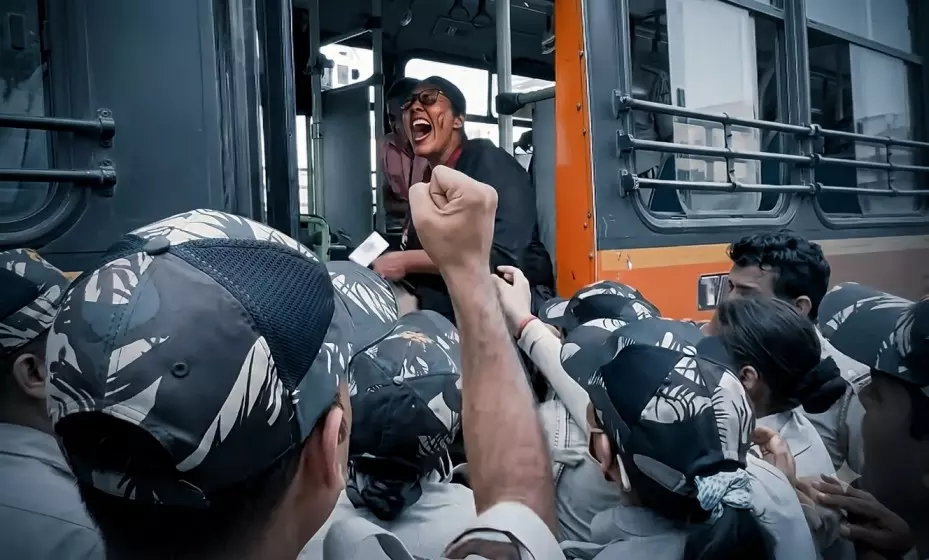
Journalists were detained despite showing press cards and despite the Supreme Court order. Image edited using Gemini AI
A glimpse into what happened to the people whose job it was to document the crackdown, and the people whose job it was to defend those caught up in it.
On the afternoon of October 11, hours after the Supreme Court directed that "lawyers, journalists and other professionals shall not be hindered in discharge of their professional duties in any manner whatsoever," advocate Arjun Chopra watched Delhi Police detain two journalists at Connaught Place.
He walked up to the officer. Why are you picking up media, he asked. The Supreme Court order is out.
The officer responded, "We haven't read it. We don't have the notice."
"This was one of the most brazen violations of the court guidelines," Chopra told Decode. The order had been passed that morning by Justices Joymalya Bagchi and V. Mohana. Its contents were widely known before noon. By the afternoon, it was already being defied, in the heart of the capital.
This was Day 2.
Over October 10 and 11, as Delhi saw its largest mobilisation yet against Chief Election Commissioner Gyanesh Kumar over the Special Intensive Revision of electoral rolls, Delhi Police carried out a sweeping crackdown that went well beyond protesters.
Journalists were detained despite showing press cards. Their phones were seized and footage deleted. Lawyers were physically prevented from reaching their clients. Community centres were turned into makeshift detention facilities with gates shut against advocates. Minors were beaten, held for hours, and denied release even after showing age proof.
The story of these two days is not about the protests themselves. It is about what happened to the people whose job it was to document them, and the people whose job it was to ensure that those detained had their rights protected. Both groups were systematically obstructed — across police stations, buses, and detention centres scattered across the city.
"Where Are Detainees Being Taken?”
"A lawyer can only meet his or her client once he knows that my client is there," said Gaurav Cyclewalla, an advocate who spent both nights tracking detainees across the city. "Since they were on a moving bus, it was impossible to guess where they were being taken. The police never tell them where. It's a wild goose chase."
On the evening of October 10, Chopra was at INA — a location where Section 163 of the BNSS had not even been imposed — when he saw people being picked up and loaded onto police buses. The detainees were told they were being taken to Bhatimines police station. They were not. Chopra followed the trail to Badarpur, roughly 20 km away.
When he arrived, police brought in five more people — escorted by six officers. Among them were two 17-year-old boys. Both Muslim.
"They were being taunted. They were being whooped on, specifically those Muslim boys," Chopra said. One of the boys was terrified, close to losing composure. The other was trying to hold it together.
Chopra asked the officers to release the minors. One of the 17-year-olds had his Aadhaar card on him. He showed it to the inspector as proof of age. The inspector refused to accept it. Under the Juvenile Justice Act, children in conflict with the law cannot be detained in this manner — they must be produced before the Juvenile Justice Board.
It took Chopra roughly an hour of arguing to get one of the minors released — the police wanted his school marksheet as proof of age, which the boy had on him. The other was taken away on a bus to Pul Prahladpur, despite Chopra telling the police he was a minor.
When Chopra followed to Pul Prahladpur, the officers' demeanour had changed entirely.
"They were being extremely rude. They told me I'll be sitting here after their work is done because they will keep on detaining people," the lawyer recalled.
Meanwhile, the boy's family sent photos of his marksheet, the evidence for his age, to his phone. But police would not let the minor access his device. They initially told Chopra they did not have the phone.
The boy had visible injuries. "On the right side of his neck, he had red marks, he was bruised," Chopra said.
He was eventually let go — but not before police recorded his personal details, took photographs, and noted his residential address. For a juvenile entitled to anonymity under the law, even this was a violation. Chopra later learned that allegations against the minors were being written up and shared in police WhatsApp groups.
Decode reached out to Delhi Deputy Commissioner of Police, Sachin Sharma, who has not yet responded. We will update the story if we receive a response.
Gates Shut; Phones Snatched
That same evening, a group of advocates drove for over an hour from Lajpat Nagar to Kapashera police station after receiving a call that detainees — several of them independent journalists and YouTubers — were being held there. When they arrived, the gate was locked.
"Police station is a public property. Anybody can enter. But they had locked the gate. We had to talk to detainees through it," a lawyer who was on the ground across both days told Decode on condition of anonymity.
Inside, detainees had been shown a large water tank with no way to drink from it. The washrooms were filthy. The lawyer had to argue, from outside the gate, with the inspector to get the women access to a washroom. Among the detained was a minor who was eventually released after roughly two hours.
On the drive back from Kapashera, the lawyer discovered their car tyre had been slashed. The lawyer sent photographs to Decode: a gaping cut through the rubber, nothing that could be explained by a nail or road debris.
"This is a new tactic," the lawyer said. "I've only seen this in movies."
The obstruction of journalists followed a parallel track. According to the Committee to Protect Journalists, at least 37 journalists were detained across October 10 and 11, and at least five were struck by police. Section 163 of the BNSS was the stated justification — but it had been imposed only in the New Delhi district, and several detentions happened well beyond that boundary. Two journalists were detained outside Delhi entirely — in Ahmedabad and Pune.
Scroll journalist Shoaib Daniyal was detained 21 km from Jantar Mantar — outside his own home. “They tried to force me to delete the videos on my phone I had shot about the detention. When I declined to do so, they called a couple of more policemen, who also tried to coerce me to delete the videos. I refused,” Daniyal said.
BOOM lost contact with its reporter Jagriti Trisha after the police snatched her phone and put her in a bus. Newslaundry reported that police took three official phones from its reporters and an intern. The Caravan's Ryan Thomas was dragged into a bus and hit repeatedly on the head when he refused to delete footage; he was slapped and prodded with a gun butt, according to CPJ. Peek TV's Sara Khan said a male officer grabbed her by the neck and pushed her toward a female officer.
On October 5, Delhi Police had issued "guidelines" asking reporters to carry PIB or DIP accreditation cards. On October 10, police were asking media personnel whether they were YouTubers, refusing entry to those who were.
Press freedom under Article 19(1)(a) does not distinguish between a newspaper and a YouTube channel. PIB accreditation has never been a legal requirement for reporting from a public place. But even accreditation did not help; reporters with valid press cards from recognised outlets were detained regardless.
The court order changed nothing on the ground the next day.
A few hours after the Supreme Court order, Chopra saw a reporter — ID card around his neck, mike in hand — grabbed by two cops and forcibly put into a detention bus.
At least 12 more journalists were detained. The net widened to mainstream outlets: three journalists from Indian Express Hindi, including a photojournalist, were picked up. Hindustan reporter Ashish Singh was detained from RK Ashram Marg while covering an AISA protest — pushed onto a bus despite showing his press ID. Digital journalist Pragya Mishra was detained in the same area; her camera person was beaten even though both carried identification.
The Night Detainees Disappeared For Hours
The worst was yet to come.
On the evening of October 11, a bus carrying detainees picked up from Connaught Place began a long, circuitous journey through south-west Delhi. The detainees alleged that they had been made to kneel at the point of detention. Their phones were snatched and police went through the devices one by one, deleting videos and photographs.
Arjun Unnikrishnan, 30, an activist with the NREGA Sangharsh Morcha described being attacked inside the bus by the police.
“We were made to sit in rows as if they are going to shoot us the next moment,” the activist said.
Inside the bus — a vehicle ordinarily used for transporting convicts, with tiny compartments and no airflow — the detainees were allegedly hit by the police. “We were taken inside, our private parts were kicked, brutally thrashed inside the bus,” Unnikrishnan recounted in the video later.
On one of the phone calls with a detainee that Decode heard, they described being assaulted and being cut off from lawyers and medical aid. Journalist M. Rajshekhar was also among those detained.
The bus circled through Kapashera and Najafgarh for roughly an hour, evading lawyers waiting at stations along the way. By 8 PM, the detainees — beaten, disoriented, with no phones and no idea where they were — were forced into a community centre in Pandwalan Khurd, roughly 40 km from central Delhi. Shortly after, police cut off the electricity.
Cyclewalla was among those trying to get in. He and other advocates had spent hours working through sources to find the location — 28 km from where the detainees had been picked up. When they arrived, the community centre's gates were shut. Three to five officers manned the gate. Lawyers were not allowed in.
Inside, among the detainees, there were minors. Cyclewalla and other lawyers called 112. They called the principal magistrate of the Juvenile Justice Board, citing a 2020 Supreme Court judgment that JJBs must proactively intervene. When the magistrate called the SHO's office, "things started getting slightly troublesome for him — whether he's holding juveniles or not."
The detainees were eventually released between 8:30 and 9:30 PM. One had sustained a fracture.
"They have made community centres — seemingly a place where people join and exercise their democratic rights — and converted them into detention centres," Cyclewalla said.
"If they come after us, then there's nobody else"
The pattern across both days was consistent: detainees loaded onto buses and driven across the city with no information. No charges filed. No arrests made. Personal details recorded regardless. The legal basis rested on Section 163 of the BNSS — imposed only in the New Delhi district — and Section 223 of the BNS, which carries a fine of Rs 2,500. No formal charges were ever brought.
"The entire point of me exercising my liberties is that if there is any violation happening, you have to authorise it by law," Chopra said. "And I have to be communicated — what exactly am I defying? What provisions am I violating? That is not happening. This entire exercise is just to stop you from protesting."
The Internet Freedom Foundation pointed out that under BNSS Section 105, every seizure must be video-recorded and sent to a magistrate. No seizure memo, no recording, and no legal basis has been made public for any of the phones taken from journalists. "Making a journalist delete footage of police action," IFF noted, "destroys the record of how the police used their powers."
CPJ's Asia-Pacific program coordinator Kunal Majumder said the incidents "are deeply troubling and a blot on India's democratic traditions”.
The lawyer who spoke to Decode on condition of anonymity described the attitude of police towards advocates as "specifically vindictive." At Kapashera, the lawyers were not even allowed to bring water in from outside.
At Pandwalan Khurd, lawyers were told to enter one by one — making it impossible to identify how many people were being held, who among them were minors, and who was injured.
At a separate police station, the lawyer personally verified injuries on a detained Muslim man. The man had described his injuries to the doctor against police orders. On the way back, a police officer used a slur and told the man he had come there "to get his mother raped." The man did not want to file a complaint.
"I don't care about the crackdown as much as I care about the fact that we were stopped from doing our job," the lawyer said. "If they come after us, then there's nobody else."
As for journalism, India is currently ranked 157th out of 180 countries in the 2026 World Press Freedom Index.