
Inside The 10 Crore PR Machine Behind Arunachal’s Mega Dam
NHPC hired a PR agency to shape public opinion around a mega dam in Arunachal Pradesh. When local influencers refused, the campaign turned to creators in Delhi and Mumbai. And then to AI-generated videos.

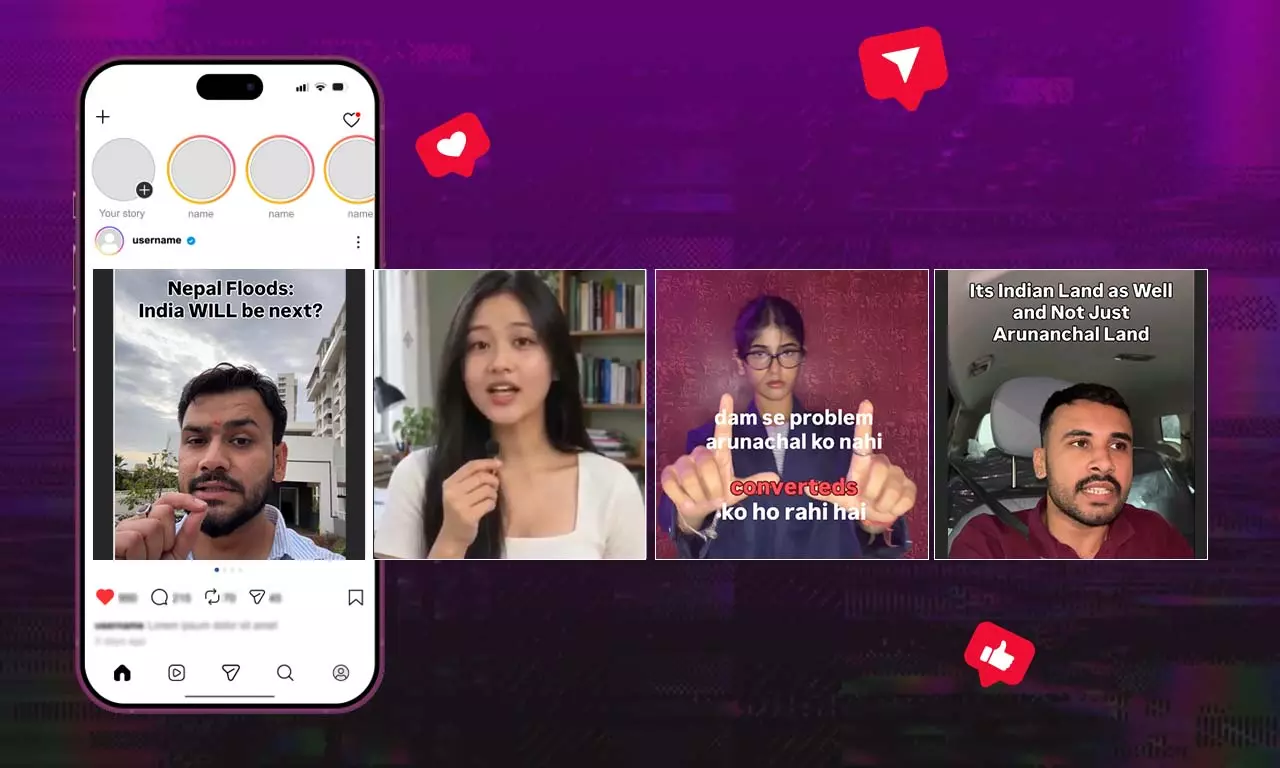
This story traces how public money became Instagram reels, and what that means for the narrative war of the ecologically fragile Siang dam.
Angun S Langkam, a creator based in Roing in Arunachal Pradesh's Lower Dibang Valley, posted her first video about the proposed Siang dam in the second week of October. She had been protesting on the ground for weeks. The video was a response to mainland Indian creators who had been calling Arunachali residents "mad" for opposing the 11,200 MW Siang Upper Multipurpose Project.
Within days, Langkam's photo — along with those of other Arunachali women creators — appeared on an Instagram page, edited into obscene gestures. One creator's image was altered to make her appear bald and circulated as mockery. The DMs were worse.
"People were saying, 'You are Chinese,' 'You take Chinese funding,' 'When people from your region come to the mainland, we will murder you and throw you away,'" Langkam told Decode.
"It's so scary."
She wasn't alone. Arunachali creators who spoke against the dam were called "momos," told their eyes and noses "all look the same," and warned of violence if they came to the mainland. Several of Langkam's peers stopped posting. Comments were turned off across accounts. DMs were restricted.
What struck Langkam wasn't just the abuse. It was how coordinated the pro-dam content felt. "They mocked our facial features, they used the same lines, the same arguments," she said. "It didn't feel like random people. It felt organised."
It was.
NHPC Limited, the central government hydropower company behind the proposed dam, had awarded a PR contract worth ₹10.91 crore to manage public perception around the project. The strategies included recruiting local influencers, engaging national media, and building a "positive, persuasive narrative" on social media. When local creators refused, the campaign moved to mainland influencers and AI-generated videos.
The trail leads from a government procurement portal to Instagram reels, Facebook pages, and the threatening DMs flooding Langkam's inbox.
The PR Contract
The proposed Siang Upper Multipurpose Project has sparked widespread protests across the Upper Siang and Siang districts of Arunachal Pradesh, internet shutdowns, action against journalists and activists, and the detention of protesters under the Unlawful Activities (Prevention) Act.
Meanwhile, there was a PR campaign running on social media, attempting to change the narrative reel by reel.
Concept Public Relations India Limited was awarded a contract worth ₹8.73 crore for 12 months, from August 7, 2025, to August 6, 2026. The contract was later extended by three months for ₹2.18 crore, taking the total to approximately ₹10.91 crore and extending the engagement until November 6, 2026. The contract was executed through the Government e-Marketplace (GeM) portal and is publicly available. The details were first reported by Bengia Ajum in the Arunachal Times.
The monthly cost was estimated at ₹72.75 lakh. It would cover 40 project staff, two NGO collaborations, 10 media-management engagements, four community-engagement events, 10 local social-media influencers, two national-media engagements and 10 skilled communication officials, along with provisions for local-media travel and contingency expenses.
The scope of work, which Decode has reviewed, is explicit about its purpose. "In light of growing negative discourse surrounding the USMSP, the strategic communication proposal aims to counteract misconceptions and build trust, fostering a positive public perception within the local, regional, and national communities simultaneously," it states.
The strategy operates at three levels. At Level 1, "Ground Zero," covering the Siang Basin, the plan calls for engaging "key micro-influencers (Gram Budas, Community Leaders, Priests, School Headmaster, local youths etc.) as well as the local communities, NGOs and indigenous groups directly to showcase the criticality of the project with positive, persuasive narrative." At Level 2, covering Itanagar, the aim is to influence state government officials, NGOs and state media. At Level 3, covering Delhi, the goal is to "position the project as a key component of National development."
The Pitch To Local Creators
The campaign's first move was to recruit influencers in Arunachal Pradesh itself. Concept PR approached multiple influencer marketing agencies to onboard local and hyperlocal creators, according to journalist Bengia Ajum.
One of those agencies was Creator Hub, which had previously worked with Arunachali creator Taba Reema on a skincare campaign. A representative asked Reema to submit a six-month influencer campaign plan targeting 31,000 people across 40 villages. The brief asked for "positive messaging around the proposed dam, addressing concerns and highlighting opportunities for the communities, especially relocation."
The quoted rate was approximately ₹15,000 per reel.
Reema refused and posted about the approach on Instagram, saying she stood with her people and would not participate in what she considered a propaganda exercise. Langkam was also approached. She too refused.
But the pressure went beyond recruitment. Reema told Decode that several influencer friends of hers have stayed silent on the dam despite opposing it — not because they were persuaded, but because they were afraid. "They are scared that they will not get any more work," she said.
"They even appealed to me not to speak up, fearing backlash and losing brand deals." Reema is the only Arunachali creator who has publicly shared the screenshot of the approach and refused on the record.
AI Women And A Facebook Page
Ajum said the campaign's initial attempts had limited success. "The contract started in August 2025, but it took more than a year for Concept PR to actually begin building a narrative on social media," he told Decode.
"They did try to bring journalists from other states to build a favourable narrative, but that couldn't sway opinions on the ground.”
What came next was stranger. The campaign produced AI-generated videos featuring a computer-generated woman whose facial features were designed to resemble people from Arunachal Pradesh, appearing to bust myths and present facts about the dam.
Decode found that these videos were posted from a Facebook page called Save Siang, which began posting on September 30, 2026. The same page also reposts YouTube videos by pro-dam voices.
The Arunachal Pradesh Directorate of Information and Public Relations (DIPR) posted several of these AI videos on X from October 9 onwards. Before that, the handle had been largely inactive, with its previous posts dating to July.
"These videos were rather amusing and difficult for people to relate to," Ajum said.
Having failed to onboard local influencers, the campaign turned to creators in Mumbai and Delhi.
The mainland creators
A viral reel posted on October 26 by @creatingchaaoss opened with: “Bhai, tum Arunachal wale pagal-wagal ho gaye ho kya?”
“China is building a 60,000 MW dam upstream. India has no choice but to build one too. Do you want to drown?" The creator posted three days after protests had turned violent in Geku and Pasighat.
The account is part of a cluster. Several handles posting pro-dam content carry superhero names — Batman, Superman, Thanos — alongside the phrase "Team Charming Chaos" in their bios. Most follow one another.
Raavi Vishwakarma, based in Madhya Pradesh, runs the parent account @charmingchaoss and describes himself as someone who helps politically inclined creators build reach and engagement. "We have a team of five people, four girls and one male member," he told Decode.
"It's like open-source coaching and nothing commercial. A group of politically like-minded people helping each other grow content on social media."
The team's content goes beyond advocacy. @Pockettdynamo (10,200 followers), who identifies as Team Charming Chaos's "Spiderman," has posted videos calling dam protesters "rice bags" and warning that all of Arunachal will be "hit with a tsunami" if the dam is not built.
In one post, the account stitches together videos of Arunachali creators and invokes the case of Bhanu Tatak, an activist booked for allegedly accepting foreign funds, a talking point that recurs across pro-dam accounts. Many of these groups’ accounts have attacked what they call the "civic sense" and "aesthetics" of Arunachali people, pointing to hostile comments they say they have received.
Asked whether he had received any communication from Concept PR or been paid to create content about the dam, Raavi denied both. "I am making content in the national interest, not for money."
The @creatingchaaoss account has been posting stitch videos targeting Arunachali creators, including claiming that "it's the converts of Arunachal who have a problem with the dam."
Several Arunachali creators called out Raavi and his team for mocking their dialect.
In his defence, he told Decode, "We are from Madhya Pradesh. We are also called Poha and Jalebi by many. So many South Indians are also called Idli and Dosa. Does that hurt our sentiments?"
Aditya Singh Chauhan, who runs @adityadebunks, and has been sharing the same views as Raavi’s team, said, "If development is needed, then our lands will also be procured by the government and we will be given compensation. This emotional and sentimental value for a river doesn't work.”
Aditya Singh Chauhan, who runs @adityadebunks (59,500 followers) and whose bio reads "being weak is a sin in geopolitics," has been posting similar content. His profile features stitch videos targeting Arunachali creators who have recently gained visibility after appearing on Samay Raina's India's Got Latent — particularly Geni Kamki and Chello Meme, both of whom have spoken against the dam and expressed solidarity with the Arunachal protests. Chauhan has questioned their right to restrict others from speaking about Arunachal, arguing that Indian taxpayers' money, channelled through central funds, goes towards the state's development. He has framed the dam as a matter of national security whose strategic implications are being "misinterpreted by these content creators”.
"If development is needed, then our lands will also be procured by the government and we will be given compensation. This emotional and sentimental value for a river doesn't work," he told Decode.
Asked about the PR campaign, he denied taking money. However, he defended creators who did, saying, "From Congress to Samajwadi Party to BJP, all have separate funds for social media influence. Influencers need to run their households.”
Same talking points, different accounts
Beyond these smaller creators, several larger geopolitics-focused accounts — with followings ranging from over 100,000 to nearly a million — have been posting videos about the dam. These include @vivekonpoint (Vivek Sehrawat), @kahani.on.the.run (Kartike Garg) and @manvendraa.chauhan (Manvendra Chauhan). These accounts have been producing political, geopolitical and foreign policy content for years.


Their Siang content takes a data-heavy approach — explaining how China could weaponise water by releasing massive volumes from its upstream dam, how tunnels in the Tsangpo region could facilitate the project, and why India needs to respond. The videos use Google-sourced images of Chinese infrastructure.
Decode identified a recurring set of talking points across these accounts and the smaller ones: China's proposed 60,000 MW dam on the Yarlung Tsangpo, India's 11,200 MW response, the "ticking water bomb" threat, a deepfake video attributed to a Pakistan Army general, references to activist Bhanu Tatak, alleged foreign funding of anti-dam voices, and the framing of opposition as anti-national. The same arguments, often in the same sequence, appear across accounts that otherwise have no visible connection to one another.
Most of this content appeared from August 2026 onwards, with a sharp surge in October — the same period as the ground protests and the Concept PR contract extension. Decode reached out to many of these creators through emails and Instagram DMs. None responded. Whether their content is part of the paid campaign or independently produced remains unclear.
The exchange has also turned ugly from the Arunachali side. Comments on pro-dam reels included: "Your worshipping of the Ganga has made it one of the most polluted rivers" and "People who don't even know where the Siang is located cannot preach to us about our rivers." Others pointed out that the creators seemed indifferent to the possibility of 27 villages being inundated and nearly 1.5 lakh people being displaced.
Sanskar Rai, an engineering student in Calcutta who runs @samosakalalchutney, represents viewers whose understanding has been shaped by watching the virtual war play out. "The constant talk about how Arunachal Pradesh belongs only to its residents and that people across India have no right to speak on their issues is completely wrong," he told Decode. "Last I checked, Arunachal is part of India."
No tags, no trail
None of the pro-dam reels reviewed by Decode carried a paid-partnership disclosure.
Vikram Raj, Civic Literacy Manager at the Internet Freedom Foundation, said the gap is structural. "The spend has moved from party-labelled ads to creators. Influencer collaborations were a major plank of online campaigning across parties in the 2024 election, and the model is now permanent rather than seasonal."
The money, he explained, usually flows through an agency or digital war room, which briefs creators and pays them. The content goes out as personal opinion. "The Supreme Court noted in the electoral bonds judgment that parties use influencers precisely to dodge expenditure disclosure. The gap is that the ECI's rules and Meta's Ad Library only capture content labelled as an ad. A reel posted 'organically' appears in neither," Raj said.
"Our concern at IFF is not that creators get paid. It is that the public, the ECI and the platform have no way to tell which political speech is bought."
Decode reached out to Meta seeking clarification on the limitations of its Ad Library in identifying content that may be sponsored or financially incentivised but is published without a paid-partnership label. This article will be updated if a response is received.
On the organised harassment targeting creators on both sides, Raj identified two layers. "One is party-adjacent: the IT cells and agencies that seed hashtags and talking points, the same supply chain as paid endorsement content but pointed at a target. The other is semi-independent harassment networks that activate when a topic trends because outrage pays. The DMs, morphed images and doxxing usually come from the second layer, which gives the first deniability."
On the ground
While the narrative war plays out on Instagram, the ground situation in Arunachal Pradesh remains tense.
Tagori Mize, spokesperson for the Siang Indigenous Farmers' Forum (SIFF), was travelling to meet released detainees when he spoke to Decode. "We are opposing the mega dam because our very existence is in danger," he said. "The Siang river is our mother and our identity. Our livelihoods depend on agriculture and horticulture. How can you compensate us for that?"
Monetary compensation cannot replace ancestral land, Mize said. "We can earn money elsewhere, but we cannot create another identity for ourselves." He questioned the process, alleging that the required consent and consultation had not been followed before the MoU was signed. "We are Indians, and we are proud Indians, but the way we are being treated is wrong. Is this democracy? We are not against development, but you cannot impose a project on people without their consent."
Police and paramilitary forces have been deployed in the region. Young protesters, including women, have been targeted. Tear gas has been used. Mize said people are increasingly afraid to step outside their homes. "Everything can be resolved through dialogue. Remove the paramilitary forces. Follow the proper procedure. Consent is necessary."
The Chief Minister's office has conveyed that the state government "commits to resolve sincerely and in a transparent manner all issues of concern to the Adi community through a mutually agreeable roadmap," asking SIFF leadership to communicate a preferred date for dialogue and a list of delegates.
Decode reached out to NHPC and to Concept Public Relations India Limited regarding the PR contract, the influencer engagement strategy and the AI-generated videos. This article will be updated if a response is received.
Edited by Adrija Bose