
Virtual Custody: Kashmir's GPS Ankle Monitors Are Haunting Homes
Lower courts in Jammu and Kashmir are strapping electronic tracking devices onto people as a condition for bail, even after India's Supreme Court ruled that such real-time surveillance of an accused person violates the right to privacy.
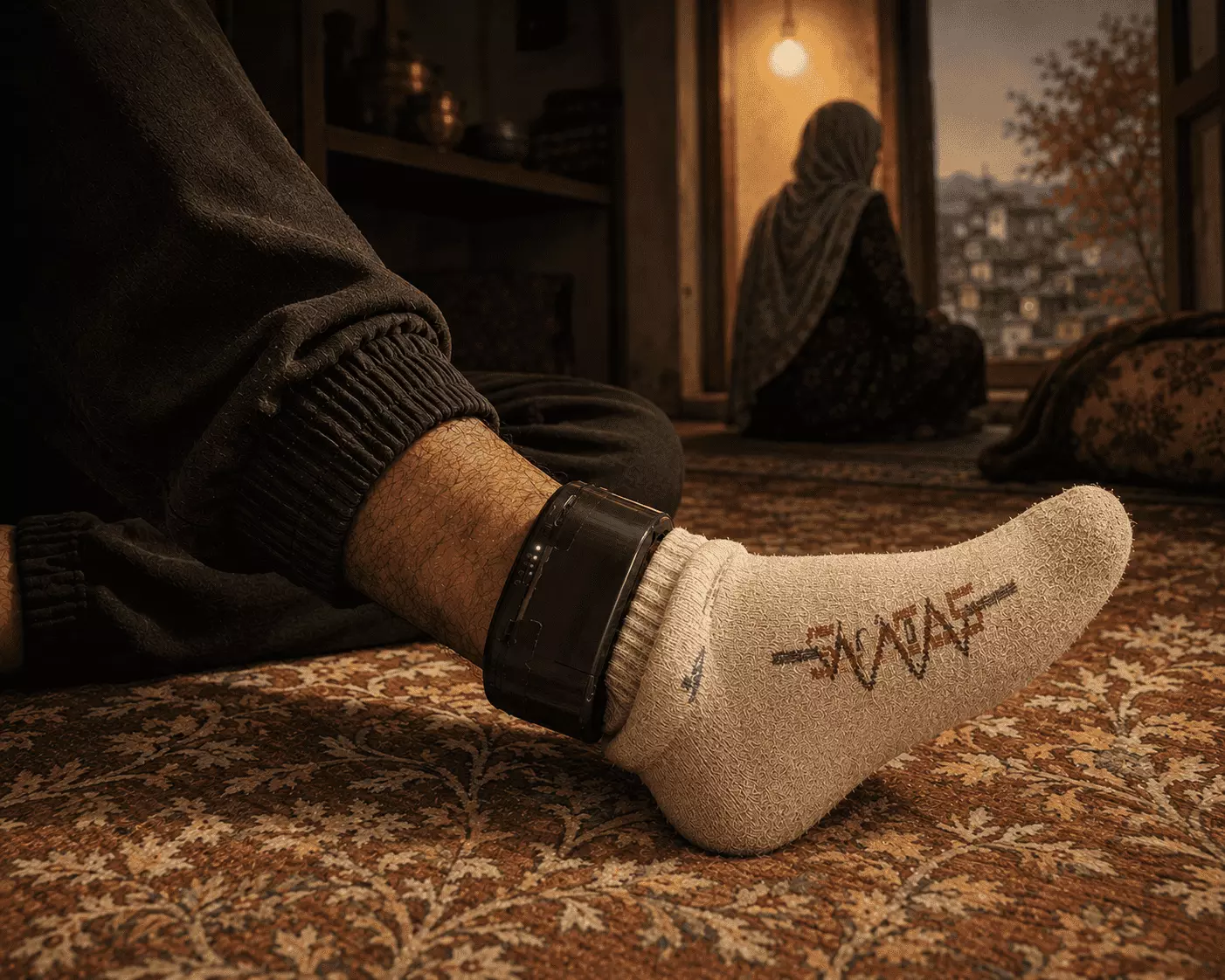
When Aamir* was offered bail with a GPS tracker months after his arrest, he accepted. So did his parents. Image altered with AI.
This is a story about what happens when the state doesn't just watch a person; it moves in with their whole family.
Srinagar, J&K — When Sameer* came home on bail last year, his family celebrated for three days. The women of the household stayed busy in the kitchen. The aroma of rice and mutton curry filled their home. Relatives arrived from two neighbourhoods over, old grudges set aside for the occasion. Children who had grown entire inches in Sameer's absence were pushed forward to greet him.
The problems started soon after.
"At night, after everyone was asleep, I could see it from where I lay," said Sameer's ailing mother.
She was talking about the GPS ankle monitor — a black plastic cuff fastened around her son's leg, the condition that bought his release.
"It would keep flashing. A small green light. On and off. On and off."
She paused. "I asked Sameer to sleep in the other room."
She did not apologise for this, but the admission weighed on her: despite cooking her son's favourite meal for his return, she had sent him and his blinking ankle to another room because she could not sleep with it in her sight.
"I did not understand what was happening to him, I was frightened," she said.
Sameer's family is not alone. Across Jammu and Kashmir, courts are ordering people out on bail to wear GPS ankle monitors — a first for India, and a practice that continues even after the Supreme Court ruled that this kind of round-the-clock location tracking violates the right to privacy. What began as a tool for a handful of terror suspects has since spread to narcotics and other cases too — leaving families like Sameer's to live, quite literally, with the state's watch in their own home.
How It Started
GPS ankle monitors use satellite positioning to track a person's movements in real time. They are common in criminal justice systems in the United States, the United Kingdom, and parts of Europe.
In India, they were virtually unknown until November 2023.
The courts had previously imposed phone-based GPS tracking as a bail condition — most notably on activists Vernon Gonsalves, Arun Ferreira, and Shoma Sen in the Bhima Koregaon case, where the Supreme Court required them to keep their mobile phone locations active and paired with the investigating officer around the clock.
But a device physically fastened to a person's body had never been used in India until a Special National Investigation Agency (NIA) Court in Jammu ordered one fitted onto Ghulam Mohammad Bhat, a 65-year-old lawyer and former associate of the late Kashmiri separatist leader Syed Ali Shah Geelani, who was accused under the anti-terror Unlawful Activities (Prevention) Act (UAPA). Bhat had been in custody since 2011.
The J&K Police's State Investigation Agency (SIA), which manages the programme, described it at the time as a technology-based tool for preventing and tracking criminal activity.
According to a report in ThePrint, the devices are manufactured by an unnamed Indian firm, and the police were in the process of acquiring more. The tracking is managed through a centralised system, with plans to extend the capability to individual police jurisdictions.
The device itself bears no visible brand markings. It is a rectangular black plastic unit, roughly the size of a thick TV remote, with four magnetic charging pins on its top surface.
Decode photographed the device on an accused six months into his bail — the outer casing had already begun to crack and peel, the plastic separating from itself in the middle, with what looked like adhesive residue dried underneath. Nearly a year later, he is still wearing the ankle monitor.
His mother became convinced the device could listen to conversations inside their home.
Decode has identified at least 12 cases across Jammu and Kashmir where GPS ankle trackers have been imposed as bail conditions. The figure is conservative, based on cases independently confirmed through court records and reporting. Press releases issued by the J&K Police confirm deployments across multiple districts, including Baramulla, Kupwara, and Sopore, in both UAPA and narcotics cases.
The technical monitoring and backend operations of the trackers, according to multiple sources within the police department and lawyers familiar with the cases, are managed from Delhi, not locally within J&K.
Multiple serving police officials confirmed the broad details of the programme to Decode, but declined to speak on the record, citing the sensitivity of ongoing investigations.
The Court Orders
On 8 July 2024, the Supreme Court ruled in Frank Vitus v. Narcotics Control Bureau (2024 INSC 479) that a bail condition requiring an accused to share GPS location with investigators violated the right to privacy under Article 21 of the Constitution. "Constant vigil cannot be kept on every movement of the accused released on bail by the use of technology or otherwise," the Court held, "as it will infringe the rights of the accused guaranteed under Article 21, including the right to privacy."
The Frank Vitus ruling did not address GPS ankle monitors by name. But the principle the Court established — that bail conditions enabling real-time tracking of an accused person's movements violate Article 21 — applies with at least equal force to a device bolted to someone's body around the clock. A Google Maps PIN can be switched off. An ankle monitor cannot.
"I don't think it is legally tenable," said Utkarsh Singh, a lawyer at the Supreme Court. "Once the Supreme Court has pronounced that GPS position cannot be asked for as a bail condition, subordinate courts cannot reimpose conditions that run contrary to that judgment."
The practice has also reshaped bail litigation in J&K in an unexpected way. According to a lawyer who spoke on condition of anonymity, some families now proactively request that courts permit GPS trackers as a condition of bail — seeing the device as the only realistic pathway to securing release. Whether such applications are accepted depends on the judge.
"Ultimately, it comes down to judicial discretion," the lawyer said. "Different judges take different views on whether such a condition is legally justified and proportionate."
What Consent Looks Like Under Duress
When Aamir*, another J&K resident, was offered bail with a GPS tracker months after his arrest, he accepted. So did his parents.
"We only wanted him back," his father said. "We did not really understand what we were signing for. We knew there was some condition, but all we cared about was bringing our son home."
Advocate Apar Gupta, founder of the Internet Freedom Foundation (IFF), described this as coerced consent. "An undertrial facing UAPA's near-impossible bail standard will 'agree' to anything," he said. "That is not consent — not when it comes through a condition imposed in bail based on the submission of the accused."
The bail conditions are not standardised and vary from case to case. According to lawyers familiar with the proceedings, whether a GPS ankle monitor is imposed depends on the judge hearing the bail application, the recommendations of the investigating officer, and the nature of the alleged offence. There is no uniform template.
The Household Under Surveillance
Aamir's mother, who cannot read or write, never fully understood what the device was. But she knew it was to be feared.
Sometimes, authorities would call and tell Aamir the device was not properly transmitting. Other times, they would say it was not showing what it was supposed to show. Each call sent a wave of anxiety through the household. His mother became convinced the device could listen to conversations inside their home.
When this reporter first visited the family, the mother was nowhere to be seen. Her husband explained that she was tending the kitchen garden behind the house.
"She gets very restless when people talk about Aamir," he said. "If someone mentions the jail, the case, or the tracker, she becomes anxious." He paused. "She is always worried that she might accidentally tell someone about the device. She gets visibly stressed when the subject comes up."
The tracker was fastened to Aamir's ankle. But the anxiety it produced had settled across the entire household.
"When someone is required to wear a GPS tracker, the experience is not only legal or logistical," said Dr. Tara Well, associate professor of psychology at Barnard College, Columbia University, in an email interview to Decode. "It can also change the person's felt relationship to privacy, the body, and the home."
If a person feels continuously observable, even through an automated device, the nervous system can remain in a heightened state of vigilance — disrupting sleep, producing bodily tension, irritability, or a chronic sense of unease. "The feeling of never being fully 'offstage' can be stressful, especially when it enters the home," Well said. Family members often begin reorganising themselves around the monitored person's stress — trying not to upset them, anticipating problems, managing moods, absorbing anxiety.
Faith M. Deckard, an assistant professor of sociology affiliated with UCLA's California Center for Population Research, called electronic monitoring a "household experience" that reshapes daily routines around curfews, battery life, and court rules. "Beyond structuring how people spend their time, it also becomes a household-wide mental tax," she said, "a low-grade, chronic stressor that they experience consciously and subconsciously as they navigate daily life."
That burden, Deckard said, falls disproportionately on women. Cultural expectations position women as natural caretakers — the ones expected to absorb the additional labour and emotional weight.
"The criminal legal system disproportionately targets men, resulting in spillover effects being experienced by the women in their lives."
In Sameer's home, the women could not sleep and began avoiding the corridors of their own house.
The everyday chatter was reduced to whispers — because they no longer knew what privacy meant in a home that no longer felt private.
A Life Measured in Jogger Pants
For Aamir, the tracker has shrunk the boundaries of his daily life. He wakes up every day with nowhere in particular to go. The young man who once spent hours playing cricket with friends now moves between his room and the courtyard. "I was very active before," he said. "I would play cricket for hours. My friends used to tease me and say that cricket was my girlfriend."
Months of inactivity have taken a physical toll. He has gained weight and withdrawn from the activities that once structured his days. Even getting dressed has become a reminder.
"Most of the time, I can't wear the clothes I like because jeans and trousers are loose around the ankle, and the tracker becomes visible. My life is jogger pants now."
The fear is not only that people will notice the device, but what they will assume once they do. In a place where rumours travel fast and social reputations are hard to rebuild, the tracker transforms an invisible legal condition into a visible mark.
"The visibility of the ankle monitor matters," said Dr. Well. "A person wearing it may feel that others are not seeing the whole person, but instead seeing the legal situation first." That kind of exposure can produce shame, body-related self-consciousness, and a feeling of being reduced to a single marker.
The ankle monitor has compounded the uncertainty surrounding Sameer’s future. His parents are elderly, and his mother is frequently unwell. His two older brothers, both daily-wage labourers with families of their own, struggle to support the household while the case drags on.
"Who will give him a hand in marriage now?" his brother asked.
"He has already lost so many years of his youth in jail, and now he has to live with this tracker. We don't know how long the case will continue. By then, he may have crossed the age when people usually get married. We don't think much about it anymore because it is beyond our control."
No Law, No Safeguards
There is no statute in India authorising continuous bodily tracking of a person on bail. No legislation governs how GPS location data from these devices should be collected, stored, shared, or deleted.
This absence sits at the centre of the constitutional question. In its landmark 2017 Puttaswamy judgment, the Supreme Court held that any intrusion into privacy must satisfy four standards: legality, legitimate purpose, proportionality, and procedural safeguards.
"GPS anklets fail at the very first step," said Gupta, "as there is no statute in India that authorises continuous bodily tracking of an accused. Neither the Bharatiya Nagarik Suraksha Sanhita's bail chapter nor Section 43D(5) of the UAPA contemplates it. A bail condition invented by a court order is not 'law' in the Puttaswamy sense."
Singh, the Supreme Court lawyer, said, "Bail is supposed to restore a person's liberty. When a GPS tracker is strapped to someone's ankle, the person may be outside prison walls while remaining under constant state surveillance. In effect, it creates a form of 'virtual custody' — custody enabled by technology."
The data questions are equally unresolved.
"Who receives the location feed — the district police, the State Investigation Agency, or a private vendor whose servers host it?" Gupta asked. "How long is it stored, who can access it, and can it be mined for other investigations or shared with intelligence agencies? No rule answers any of this."
As far as Decode's reporting has established, no formal legal challenge to the use of GPS ankle monitors has been filed in Jammu and Kashmir. There is no Public Interest Litigation before the J&K High Court, nor any reported petition directly challenging the constitutionality of GPS-based bail conditions. No bar association or civil liberties organisation in the region appears to have taken up the issue publicly.
Expanding Reach
Gupta described the J&K trajectory as "the moment surveillance moved from our phones onto our bodies."
The J&K Police first sought ankle monitors for terror accused, he said, but the practice eventually expanded. When the devices were first introduced in 2023, security establishment sources told reporters that the range of criminal cases for which ankle monitors would be sought "will also be increased and will include domestic violence too."
"That trajectory — beginning with 'terrorists,' expanding to everyone — is the standard function creep of surveillance in India," Apar Gupta said.
"We saw it with Aadhaar, facial recognition, and drone policing," added Gupta.
The practice is also spreading beyond J&K. Last year, Punjab's Director General of Police publicly cited the J&K programme as a model and said his force was examining GPS anklets for drug smugglers released on bail.
In a study published in the Utah Law Review, researcher Sara Zampierin argued that digital trackers do not replace prisons — they move the boundary of the prison into the private family home, turning family members into unwilling guards and domestic spaces into sites of constant state observation. The researcher described this pattern as "mass e-carceration."
"Electronic monitoring is not only invasive, but ineffective," said Aaron Mackey, Deputy Legal Director at the Electronic Frontier Foundation. Drawing on US studies, Mackey said there is little evidence that electronic monitoring significantly improves court appearance rates or reduces re-arrest. "To the contrary, these studies indicate that law enforcement is using electronic monitoring to surveil and constrain the liberty of those who wouldn't otherwise be detained."
The technology is also unreliable. Gupta pointed to research from the University of Chicago that found ankle monitors are highly prone to false alarms due to poor GPS signal and weak cellular networks.
"In India's network conditions, a dropped signal can become a fabricated bail violation and a return to jail," he said.
At least one person interviewed by Decode described repeated instances in which connectivity issues appeared to trigger police concern. Officers would call to say the tracker was "not showing what it is supposed to show." These incidents typically occurred in areas with poor mobile network coverage.
Each time, the person was instructed to report to the local police station, often at short notice. "I have to call my father, and he has to leave whatever he's doing to come with me," he said. "We both have to go to the police station until they are satisfied everything is fine."
A few police officials spoke to the reporter on the condition of annonymity.
What Would Safeguards Look Like?
Experts insist that if electronic monitoring is ever to be legally deployed in India, it cannot be through ad hoc bail orders.
"A parliamentary statute, not police procurement or ad hoc bail orders, must authorise electronic monitoring, define who may be subjected to it, for what offences, and for how long," Gupta said. Courts would need to record reasons why less intrusive conditions — sureties, reporting requirements, passport deposit — are insufficient in a specific case, applying the Puttaswamy proportionality test.
Data protection, he added, must be built in by design: location data accessed only on recorded justification, stored for a strictly limited period, barred from use in unrelated investigations, and deleted upon acquittal or discharge, with independent audits of police and any private vendor.
But Deckard raised a more foundational question: whether the benchmark itself is wrong. "As long as incarceration is the reference point, we'll consider anything that isn't that a better alternative," she said. "What would it mean to move beyond a 'better than' approach to one that starts with the harm and asks — is this necessary? What are our goals? Can we accomplish them in a way that minimises the harm?"
On and Off
In the late afternoon light, Aamir's mother stood by her kitchen garden, her fingers smoothing the edges of her dupatta. She looked toward the house, where her son sat inside, his days spent in the narrow space between the courtyard and his bedroom. Outside their gates, the village carried on — cricket matches, gossip, the familiar rhythms of life.
Inside, time moved differently. It was measured in the hours spent charging a battery, the weight of a thick plastic cuff, and the ring of a phone whenever a signal dropped.
And across town, in a room she had asked her son to leave, Sameer's mother lay awake — watching a small green light blink on and off on an ankle in the dark, unable to look away, unable to sleep, unable to stop being afraid of something she could not name.
Names have been changed to protect the identities of those involved.
This story is developed with support from the Asia Pacific Forum on Women, Law and Development (APWLD)’s Media Fellowship on Digitalisation and Feminist Digital Rights and Justice.
Edited by Adrija Bose