
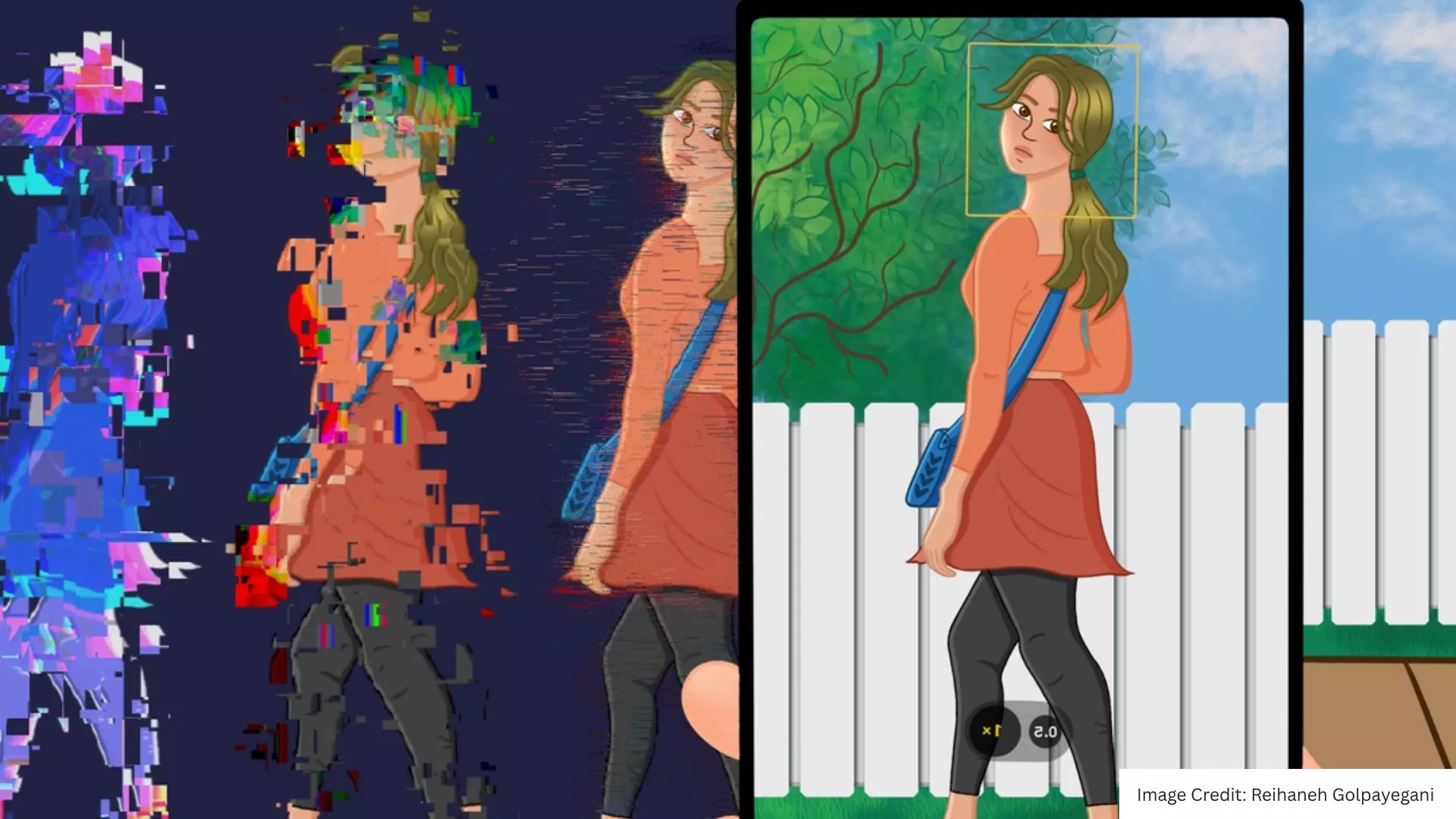
Reihaneh Golpayegani / https://betterimagesofai.org / https://creativecommons.org/licenses/by/4.0/
This story was supported by the Pulitzer Center.
The Character
She was everything an algorithm rewards. Bold. Consistent. Profitable.
On Instagram, ‘Babydoll Archi’ was an unapologetic survivor — a woman who had spent six years as a sex worker on Delhi's GB Road, paid ₹25 lakh to buy her freedom, and was now living, defiantly and publicly, on her own terms.
Her tops were revealing, her poses confident.
She geotagged herself across Indian cities. She posted charity donation receipts. The post where she appeared alongside American adult film actress Kendra Lust went viral. The follower count went from 82,000 to 1.4 million in days.
An entertainment outlet ran a 1,200-word profile of her journey to the international stage that read like a publicist’s brief. National media published her biography and estimated her net worth at ₹20–40 lakh, earned from "sponsored posts, affiliate deals, and modelling."
On Telegram, subscribers could access explicit content. Links directed them to "full nude videos."
She was the perfect internet lore.
She was not real.
The viral sensation was a homemaker in a small town in Assam, completely unaware that her ex-boyfriend from college had been using Artificial Intelligence to place her face onto bodies that didn’t belong to her.
Pratim Bora, a 30-year-old mechanical engineer, had built a business around the character he had made of her, dressing and undressing her to the whims of paying subscribers.
When the police arrested him in July 2025, five years had passed. The same media that had amplified the fake persona without any verification now amplified his arrest with equal enthusiasm. The real woman, whose name had by then been indexed on pornographic websites, retreated from public life.
Bora was cast as the mastermind. The story closed neatly around him. But the economy that made “Babydoll Archi” possible did not.
This is a story about how that economy works.
Decode and Tattle spent three months mapping the supply chain of AI-powered undressing tools — applications, bots, payment networks and the platforms that host them — that make the non-consensual undressing of women a commercial activity.
Startups backed by venture capital make money from the use of AI on non-consensual images of women. Telegram bots recruit Indian payment agents on commission. AI models built to generate sexual content of South Asian women run on Chinese software, distributed through American platforms. At every link in the chain, money changes hands.
At the centre of each transaction is usually a woman who has no idea that her face is being used to run it.
On a swampy night in July last year, Lila Kanta Bora watched, with disbelief, as the police packed his youngest son, Pratim, into a car and drove away.
Lila is seventy years old and retired from the Public Health Engineering Department of Assam. In the years since leaving government service, he has built an ordinary but orderly life — selling packaged milk and his wife's homemade pickles in their small grocery store, judging Bihu competitions every spring, spending his weekends at the naamghar (community worship hall) of his town.
He is the social one in the family, neighbours will tell you.
Pratim was always the quiet one. The studious one. The engineer.
Pratim's father runs a small grocery store in Tinsukia, a bustling commercial town in Assam | Illustration: Arjun Chopra (edited with AI and Adobe tools)
The neighbours saw the police arrive at their rented two-storey home, tucked away in a leafy lane of Tinsukia, a small and bustling commercial town in Assam. They don't ask questions, Lila said — but they look at the family differently.
They know what his son did. There are whispers: "He morphed a girl's photos"... "She was in a relationship with him."
Lila can't make sense of it. "He was a smart boy," he said. "Good in his studies."
He paused.
"He has been framed."
Since the arrest, Pratim’s bank accounts have been frozen, and the financial burden has fallen on his father.
"He was always interested in drawing and designing,” he said. After Pratim moved back to Assam during the pandemic, his father recalled, he would spend hours working from home on his computer.
"That is all we knew; we never interfered, and we did not understand much more. How would we?"
What Pratim was working on, for over five years, was the fabrication of a woman.
It has been nearly a year since the arrest. The case has not moved. The charge sheet still unprepared, the forensic analysis still pending, Pratim was granted bail because the police ran out of the mandated time.
"Mur du-thengiya jontu'r uporot biswash herai gol (I have lost faith in mankind)," Lila said, in Assamese.
Revenge To Market
Pratim met the woman at a college party in Delhi around 2014, and started dating soon after. They were a year apart in the same engineering programme, with hometowns – Dibrugarh and Tinsukia — just an hour away from each other in Assam. By 2016, the relationship was under strain: Pratim felt she was cheating on him. He began accessing her social media accounts — logging in as her, messaging the man he suspected.
They eventually broke up. She returned to Assam, and he went on to work in the National Capital Region.
When he returned to Tinsukia on a break, mutual friends told him that his ex was claiming that he had forced her into the relationship. That he had taken her photographs without her consent.
Around that time, an innovation within Generative AI found an application its authors had likely not intended. The academic paper from 2014 on Generative Adversarial Networks, a method for training computers to generate realistic synthetic imagery, had by late 2017 been commodified into consumer face-swapping apps anyone could download.
On Reddit, a user called ‘MrDeepFakes’ had used the technology to place celebrity faces onto pornographic videos, coining an eponymous term: Deepfakes, digitally manipulated images strikingly difficult to distinguish from reality. It would later come to define an entire category of harm.
Within a year, companies like Reface AI had turned the same capability into a paid product.
Pratim, the police said, used the face-editing app to superimpose the woman’s face onto other women’s bodies in 2018-19. He started posting those images on the Instagram account, @babydoll_archi. He began with ten, maybe twelve images. The account started drawing followers.
"He learned it all from YouTube," a Dibrugarh-based police officer in the case told Decode.
"The initial motive was suspicion, which turned into revenge," said the officer, who did not want to be named.
"When he saw the account getting popular, he got more interested. And then when he discovered there was a way to make money, he just did not stop."
The Babydoll Archi account also had a presence on YouTube for years. The channel was still live and available when Decode wrote to the platform, ten days before publication of this story. YouTube took it down soon after. A spokesperson said the channels were "terminated for repeated violations of our nudity and sexual content policy.”
Between October and December 2025, YouTube removed more than 2.8 million videos in India for violations of the same policy.
The account Pratim had built on Instagram— @archihope94, later renamed @babydoll_archi — grew in step with the tools available to him. By 2022, face-swap technology had given way to Diffusion models, a new class of generative AI that made it possible to generate images from a text prompt alone.
Pratim joined three services built on this capability: Midjourney, OpenArt and Dzine. Each charged a base subscription of approximately $10 (around ₹830) a month.
Not all tools were used to generate sexually explicit content. On Instagram, the images were provocative and suggestive: revealing outfits, confident poses, a character being built in public. The face in every image belonged to a real woman who had never consented to any of it.
By 2023, image-to-video services were becoming widely available, allowing a face to be placed into scenarios that had never occurred — moving, posing, and apparently present. The account moved from photographs to videos. The woman's face was in both.
With every new wave of technology, ‘Babydoll Archi’ became more synthetic and more convincing. The character had a geography, a timeline, a moral arc. Audiences who had followed for years believed they knew her.
Police suspect Pratim did not act entirely alone.
He told the investigators that someone had contacted him in 2023, offering to boost the account's reach and help him monetise it. All Pratim had to do was keep making content — same face, same name. It was this person who encouraged what became the account's most viral moment: a composite image placing Babydoll Archi alongside American adult film actress Kendra Lust.
Indian media carried it without verification. Grok, the AI assistant built into X, described the character as "an Indian model, activist, cosplayer, and content creator based in Mumbai and Las Vegas." An X account posted: "Proud moment for Assam."
Court records that Decode accessed show that, despite police suspecting a wider network, no further arrests have been made since the case was first registered in July 2025.
Thirty Percent To A Bengaluru Startup
The subscription behind Pratim's account ran through a platform called ActualFans, connected to a Bengaluru startup called Renown. The link to it sat in the Instagram bio of the Babydoll Archi account, routed through Linktree — a link-in-bio tool that directed followers to exclusive content.
Founded in 2020 by two IIT-Kharagpur graduates — Ravish Kumar and Aditya Barelia — Renown had backing from Sequoia Capital's early-stage fund and Blackbuck founder Rajesh Yabaji. In 2022, while better-known creator platforms were losing money, Renown posted ₹12 crore in revenue and turned a profit for the second consecutive year. (Update at the end of this story regarding Yabaji's investment.)
The parent company, Ping Pong KGP Techno Private Limited, built Renown as a white-label monetisation infrastructure: a creator signs up and the platform generates a unique webpage on one of many domains it owns — myinfluencer.app, syke.club, actualfans.app. Across multiple URLs, the same company collects the cut.
Decode spoke with a 27-year-old creator who uses Renown as a subscription platform. For every subscriber payment, she said, thirty per cent goes to Renown, and a further one per cent to its parent entity. An overseas subscriber pays triple the charge — but the creator receives only the India-rate they set. Customer service operates through a WhatsApp number with disappearing messages enabled.
While Renown presents across interests, the creators consistently making money on it work in adult content. The 27-year-old creator, who also uses OnlyFans (OF) — the global subscription platform that pioneered creator monetisation for adult content — said that the contrast is stark. “OnlyFans has a system of verification in place,” she said.
"There's no way an AI character could have become a creator on OF. Even if someone's hand is visible on a video, it needs a consent form signed. This kind of verification doesn't exist on Renown.”
Babydoll Archi was not real. The platform took its thirty per cent, regardless.
Renown did not respond to Decode’s questions.
On the Linktree page that Pratim created, a button labelled "My First Video" sat behind a paywall — each time a user paid to unlock it, Linktree took a cut off Pratim’s take.
The police say Pratim made ₹10 lakh through subscriptions in the seven months leading up to his arrest.
In Search of a Business Model
Pratim was a customer. The services he paid for were available to anyone willing to spend a few thousand rupees.
He had plugged into a global market for non-consensual synthetic imagery, with its own model creators, platform economies, payment agents and distribution networks — and no shortage of customers.
The global generative AI market is valued at over $100 billion (around ₹8.5 lakh crore). Its peripheries are where the experiments run. Every major AI model released by a research lab or tech company comes with a set of less visible counterparts promising what the larger platform will not provide. That promise is usually described as "uncensored access."
Big Tech companies are compelled to provide some safeguards. Earlier this year, when Grok was used to generate undressed images of women who had simply posted photographs on X, regulators across multiple jurisdictions demanded explanations
The models behind these services work in two stages.
A handful of companies, because of the enormous computing power and cost involved, train large media generation models on billions of images or videos. These are broad, general-purpose tools that learn to understand and generate visual content. Companies can choose to keep their models closed, so that users can access but not adapt them. Or they can release the model weights — the parameters that emerge during training, and that can be tweaked to change the output. Anyone can take an open weight model and specialise it for a specific purpose using a dataset as small as twenty images or videos. The process, called Low Rank Adaptation (LoRA), can run on a personal computer.
The models that generate specific sexual acts, including the ones Decode and Tattle found, are fine-tuned this way.
All the video generation models we analysed used the Chinese Wan series, a family of models released by Alibaba, as their base and redirected toward an explicit purpose. None of the major American AI companies have released their video models in a form that allows this kind of adaptation.
Michelle Ding, a computer science PhD student at Brown University specialising in prevention of AI-generated non-consensual intimate content, cautioned against reading this as a straightforward geopolitical verdict. "Treating this like a geopolitical conflict shifts the narrative away from the very real harms. Countries should take this opportunity to collectively design regulatory protections so that there are fewer inconsistencies and gaps across jurisdictions,” Ding said.
In December last year, Grok generated an estimated three million sexualised images, at a rate of 190 per minute. Grok is made by xAI, an American company.
The largest platforms where these models are built, shared and discovered are Hugging Face and CivitAI, both American companies.
Two-thirds of the top trending image-and-text-to-video models on Hugging Face in April 2026 were devoted to generating sexual scenes, their names describing specific acts. On CivitAI, creators earn platform credits based on how many times their model is used — the same logic that governs viral content, applied to AI software.
Barring one exception, every model on CivitAI using the word "Desi" is designed to generate sexual imagery of women. The models include entries named "Desi Honth" and "Desi MILFs." Building models that generate sexual content of South Asian women is, on CivitAI, a viable income stream.
The models are Chinese. The platforms hosting and distributing them are American. The women whose faces and bodies are the raw material are overwhelmingly South Asian.
CivitAI, in a statement to Decode, said its policy prohibits content using "the likeness or name of a real, identifiable person, whether or not that content is sexual," and that such content is removed when identified. The company said creators earn credits only when their models are used on CivitAI's own generation service, and that models using real persons' likenesses are prohibited from earning those credits. Hugging Face did not respond to Decode's questions.
These policies do not prevent people from downloading the models and using them elsewhere. For developers wanting to build a commercial product — a Telegram bot, a website, a mobile app — the model can be downloaded and integrated.
This is where the market concentrates and where the money is largest.
The Bot Is Dead, Long Live The Bot
"Hi, I am a magical photo bot. I can make the girl in the photos... Ahem, you'll see once you try." This is how Telegram bot HotTok greets its users.
Bots, the automated service within the messaging platform, is one of the easiest ways to generate non-consensual synthetic sexual videos. A creator only needs a photograph.
Upload a close-up shot. Choose from a menu: positions, scenarios, and the length of the video. One option asks the user to select breast size from a dropdown. Another bot connects to multiple services simultaneously, offers over a hundred style options, accepts Apple Pay, Google Pay, UPI, Paytm and PhonePe, and delivers output in approximately sixty seconds.
Credits are how a user pays. They sell in bulk packages — from ₹1,019 for a basic bundle to ₹71,900 for the largest. The pricing is designed for every level of use: a one-time user, a repeat operator, or a coordinated network generating content at volume.
In late 2023, in a small town in Karnataka, a network of troll accounts was doing exactly that— producing AI nude images of women and teenagers in bulk and flooding Instagram.
One of the targets was a sixteen-year-old content creator. A harassment campaign and a subscription business like Bora's drew from the same pricing structure.
The cost is lowered further by the referral economy. One bot — whose interface can be switched to Hindi, a deliberate signal about its intended market — has 43,604 monthly users and promises "30% commission from every referral purchase." Another advertises dollar-denominated withdrawal for referral earnings.
One bot, buried in its interface, links to a channel where users can apply to become agents — accepting UPI payments from other users and converting them into credits.
Decode contacted two such Indian agents and found both connected to multiple bots simultaneously: contractors taking rupees, converting them into platform credits, earning a margin on each transaction. Clicking UPI in the credit-buying menu opens a person's Telegram account.
The agent operating under @HeroHindustani accepts UPI, PayPal, Alipay, and crypto simultaneously. Decode found two UPI addresses in this network — ertxd666@axl and devidsinghofficial-1@okicici — both traceable to accounts at India's top banks.
UPI, operated by the National Payments Corporation of India, prohibits its use for transactions involving obscene or pornographic material.
NPCI did not respond to Decode. The UPI addresses have been shared with the relevant authorities.
Most of the bots we investigated pointed to the same backend — a single piece of software hosted on a server in Europe that does the actual image and video generation. Several bots state this explicitly: "you can use your balance from bots in our API."
The bots are storefronts. The API is the warehouse. The warehouse does not close when a storefront does.
Ding, the Brown University researcher, told Decode, "If you only target nudifier applications, it is an endless game of whack-a-mole. Once you take one down, another one quickly reappears because the supporting infrastructure is still there." Her research pointed to the surrounding infrastructure — payment processors, app stores, search engines — as the more vulnerable points.
"Payment processors can cut their ties to nudifier applications. Right now all of these are monetised. That is the reason the business exists."
A bot called SinSynth advertises the ability to clone itself: "CloneUndrzzBot is one of the main features. You can clone the bot. Send your bot token to start cloning." The original developer receives income from each use of the backend regardless of which clone processed the transaction.
Telegram bots are one of the easiest ways to generate non-consensual synthetic sexual videos.
New bots and their accompanying websites appear simultaneously across Telegram channels, Discord servers and Reddit threads devoted to AI nude content — within twenty-four hours of launch.
The coordination is consistent enough to suggest centralisation behind the apparent plurality of storefronts.
The Money and the Spread
Pratim spent up to ₹60,000 a month for the American services: Midjourney, OpenArt and Dzine AI, which gave him the highest-quality output. Not every operator in this market spends at that level.
The market has built a parallel tier. Free credits for a first image or video. Paid tiers from ₹6 a week, enabling users to create undressing videos from available templates.
Someone with technical skills can download a model, host it on the cloud, and generate a ten-second clip for under a dollar. The economics of cloud computing reward persistence: running a server continuously and billing monthly costs far less per video than spinning one up for a single session. At scale, these bots are profitable.
The app a1.art — downloaded by over one crore people on Google Play, run by Hong Kong-based Jishi Design on Chinese servers — presents as a social platform for AI video art. The motivated user, following its recommendations, finds sexually explicit synthetic content. Some of them feature children.
For apps that have survived moderation on Google Play, Google's own payment infrastructure handles rupee transactions across borders.
Google Play did not respond to Decode's questions about the a1.art application or the child sex abuse material finding. This finding has been reported to the appropriate Indian authorities.
During the investigation, the a1.art app's menu featured a link to its API, which directed users to a Discord server. The server's primary language was Chinese.
The photographs being shared appeared to be of South Asian women. A user posted: "Download the photos and start generating image guys!" Another replied: "Good collection." Generated nude images from those photographs were shared in the same channel.
The platform, the API, the model — none are under Indian legal jurisdiction, and none are required to respond to Indian law enforcement without an international legal process that, in practice, is rarely initiated.
Behind all of these services is the same backbone: content delivery networks, cloud infrastructure and domain registrars that also power the e-commerce platforms and streaming services the world relies on.
Twenty-seven of the thirty-one websites Decode and Tattle investigated used Cloudflare as their content delivery network — a service that speeds up how websites load but also, as a side effect, masks the physical location of the server and the identity of whoever is running it.
This makes tracing operators across borders even harder than it already is.
Rishiti Choudaha, a researcher at the Centre for Communication Governance at NLU Delhi, describes cross-border enforcement as "bleak." A formal request under the Mutual Legal Assistance Treaty must pass through the Ministry of Home Affairs, proceed through the judicial process, and ultimately depend on whether the target country cooperates.
"It is a very time-consuming process. Even identifying the operator behind a service becomes extremely difficult," she told Decode. The informal route through Interpol, she says, is even more cooperation-dependent.
Cloudflare did not respond to Decode's questions.
Many of these services carry a terms of use stating that users must be over eighteen and may only upload consensually shared images. There is no mechanism to enforce either condition.
In August 2025, while Pratim was still in custody, a Telegram channel carrying the Assam woman's real name and face shared seven Terabox file-sharing links, all leading to explicit sexual videos.
The account that had started with twelve edited photographs in 2018 had, by the time of its creator's arrest, multiplied into dozens more that no single arrest could contain.
Many of those channels continue to operate today. The face in the posts has changed — they now use other women's photographs. The structure, the links, the audience remain.
Distribution in this economy is self-reinforcing, each channel feeding the next. The same Telegram groups that circulated her content circulate the names of new nudification bots. The same Reddit threads that promoted her subscription links promote API access to undress tools. The same SEO tactics that made her name discoverable — keywords embedded in Scribd documents and YouTube video titles— are used to make nudification services discoverable. Even Spotify and Apple Music carry links listing the best nudify tools.
The ecosystem does not distinguish between the content and the tools that produce it. Both are products, and both are distributed the same way.
The woman found out about the account the way the rest of the country did: when mainstream media began covering it. She had once had political ambitions. Then she stepped away from public life.
Her family filed a police complaint, a copy of which Decode has seen. The police registered an FIR under sections covering obscenity, forgery, criminal intimidation, defamation and sexual harassment, and later added sections of the IT Act for identity theft, privacy violation and the transmission of sexually explicit material.
"If the media had not reported on the account," the officer investigating the case told Decode, "the family wouldn't even have filed a complaint. But the media carrying it without verification really boosted the account and made her name popular."
Police raided Pratim’s home on the evening of 12 July 2025, nine days after the family filed the complaint.
The police told Decode that Meta had helped them trace Pratim through the phone number and IP data linked to the account. His mobile phone, laptop, and hard disk were seized for forensic analysis.
The officer who first questioned him described Pratim as introverted and non-threatening. During the interrogation, he said he wanted to apologise to the woman whose face he had sold as exclusive content.
The bail came on 11 September 2025 because the chargesheet had not been filed within the legally mandated sixty-day window. The forensic analysis has not come back. Ten months since the arrest, the police say it will be filed next month.
Pratim's lawyer, Raju Sharma, told Decode that the trial is yet to begin. "The material may be AI. The case is registered under the IT Act,” he said. The challenge for him, he admitted, is that "it is not very easy for me to understand how AI works" —how images can be generated from prompts, or who exactly profits from the tools that made it possible.
At the time Pratim was arrested, India had no specific statutory definition of synthetic content. Legal action on deepfakes required improvised use of provisions from the Bharatiya Nyaya Sanhita and the IT Act — sections on identity theft, obscenity and privacy violation.
Seven months later, in February 2026, the government notified the IT Amendment Rules 2026, introducing a legal category called "Synthetically Generated Information" and requiring platforms to remove non-consensual intimate imagery within two hours of a complaint.
The rules apply only to platforms that cooperate, and do nothing about the servers in other countries, the APIs, or the bots that clone themselves when taken down.
Apar Gupta, executive director of the Internet Freedom Foundation, said the rules require platforms to act quickly on non-consensual sexual imagery but remain poorly enforced. "When the state fails to create clear accountability and platforms face no real consequences, women and young people are left to carry the burden of enforcement themselves,” he said.
Persis Sidhva, an advocate in Mumbai who works on technology-related cases, is sceptical that new legislation alone changes anything on the ground. "In our experience, forensic analysis takes a very long time. Presenting tech-related data in court is another challenge. If the analysis is faulty, we continue to be in the same position — a new law doesn't change that."
In Pratim's case, the forensic report has been delayed by over ten months.
The Linktree account is still live. Telegram channels still direct users to “full nude videos”.
"The challenge is that we have his account details, but the platforms don't cooperate," the officer investigating the case said. "Meta helped us track him down, but the other companies give no information. We got no help from Linktree. We can't prove that the account actually belongs to him without the platform's help."
Linktree did not respond to Decode’s questions.
The Anonymous Network
The troll network in Belgaum, in Karnataka, had a system.
It targeted emerging content creators — women whose videos were getting traction online. It generated nude images in bulk, embedded them into their victims' own Instagram reels using a moving logo as cover, and tagged the creators so the content reached the people who already followed and trusted them.
A sixteen-year-old content creator, whose images were shared by this network, told Decode:
"I found ten to fifteen accounts. There are hundreds of such accounts posting nude images of women and young girls — AI-generated."
The synthetic nude was embedded as a brief flash mid-video, timed to slip past automated moderation. When first contacted by Meri Trustline, a helpline run by Mumbai-based Rati Foundation for survivors of online abuse, Instagram said the content did not violate its community standards.
The Rati Foundation's 2023–24 report documents the network in clinical detail: the coordinated branding, the near-identical usernames that reappeared after each takedown. One account would be removed; two would appear with slightly different spellings. The logo stayed the same. The content stayed the same. Only the account name changed.
Then there are cases where the perpetrator needs no social media account, no troll network, no following.
In April 2025, a 31-year-old woman from Assam downloaded a loan app called ScoreClimb, uploaded her PAN card and photograph as required, and within days was being threatened with AI-generated nude images made from that photograph. When she refused to pay, the image was sent to her contacts on WhatsApp. Explicit calls arrived from numbers she did not recognise. People she knew received it too.
She reached out to Meri Trustline. She had already tried the cybercrime helpline. WhatsApp, after escalation, confirmed action had been taken.
The calls stopped. She never discovered who was behind the app.
An officer at the Assam Cyber Crime Cell, speaking to Decode on background, said the ScoreClimb case was not uncommon. "There is an increasing trend of using loan apps to blackmail unsuspecting victims. Scammers use these photos to blackmail them and demand money."
Siddharth, co-founder of the Rati Foundation, has spent years tracking what has changed. "At least ten per cent of the cases we receive are about content generated or edited by AI without consent," he told Decode.
The Assam case and the Belgaum case look different on the surface — the former involved one man, one woman, and one account built over seven years; the latter, an anonymous network targeting dozens of teenagers for over a year. Both drew from the same tools, same distribution channels, and produced the same outcome: a woman's image, manipulated with AI, circulated without her consent.
"In India, there is intense shame associated with nudity and sexual acts," Siddharth said. "Harassment has relied on the believability of the survivor being involved in sexual acts portrayed in the content."
What changed is who can manufacture that believability.
"The boyfriend would have to be in possession of your nude images to threaten you. Now, anybody can tell you they will make a nude image of you.”
"Harms don't need motivation," Siddharth said. "People have been spending just to spread harm."
No Information With The Government
Decode filed RTI applications with three central government bodies — the Indian Cyber Crime Coordination Centre (I4C), the National Crime Records Bureau, and the Ministry of Electronics and Information Technology — asking how many complaints related to AI-generated intimate imagery had been received, and what guidelines had been issued to police on deepfake abuse. Each returned the same answer: no information available. The I4C stated why: complaints are automatically routed to state police, and the centre holds no operational records.
But the states are where the system falters. Only 2.43 per cent of all cybercrime complaints in 2024 in India were converted into FIRs.
Cybercrime complaints involving women in India jumped from roughly 50,000 in 2024 to nearly 80,000 by 2026 — a 60 per cent rise in two years, according to AI safety firm pi-labs. The same report estimates that 62 per cent of deepfake abuse cases go unreported entirely.
Sidhva, the Mumbai advocate, points to how the NCRB collects its data: when a case involves multiple offences, it is recorded only under the one carrying the severest punishment. If a woman faces tech-assisted abuse alongside another offence drawing a heavier sentence under the BNS, the IT Act violation disappears from the count entirely.
In Maharashtra — a state of over 120 million people — the NCRB recorded just 55 cases of cyber pornography and obscene content against women in 2024.
"The figures you see are not an actual count of what is happening," Sidhva said.
Complaints filed on the national cybercrime portal rarely prompt a follow-up from a local police station. "We always tell the victim they have to go to the police station with a copy," she said.
The Assam Cyber Crime Cell officer described what that routing looks like from the receiving end.
"Many times, the victim is in one state while the accused is in another. Suppose it is a case concerning a small loan of ₹1,500; we do not have the resources to pursue it across states."
Tracing, the officer added, is difficult by design. "You may get to the first layer, but reaching the actual perpetrator is very rare."
The Assam woman's AI-generated content is still out on the internet. In Karnataka, the teenager has gone back to posting — carefully, on an account she keeps private.
The woman blackmailed through a loan app stopped returning the Trustline's calls once the harassment subsided. Before she went quiet, she said one thing that stayed with the counsellors: that even though people may have suspected the image was fake, she felt deeply shamed as though she had been "involved in something dirty."
This, too, is part of the economy — the silence it produces. The creators who slow down. The women who withdraw. The ones who never file a complaint because the person doing it is someone they know, or because the police have told them that the system cannot pursue all cases.
Deeptrace’s 2019 State of Deepfakes report found that 96 per cent of all deepfake videos online consisted of non-consensual intimate imagery, with 99 per cent of subjects being women. A 2023 study by Home Security Heroes found the share had risen to 98 per cent.
"AI nudification tools are a way to curtail the freedom of women, to silence them," said Siddharth, co-founder of the Rati Foundation.
The market Pratim Bora plugged into will not be inconvenienced by his arrest. On a Play Store app with one crore downloads, new templates appear each day. On Telegram, a new bot is being advertised across Discord and Reddit simultaneously.
It has other faces to find.
Update, 5 June, 2026: After this story was published, a representative for Rajesh Yabaji sent Decode the following statement, which we are appending in full: "As the business evolved in a direction that differed from the original investment thesis, Rajesh exited the company in May 2023 for the right reasons."
This story has been supported by the Pulitzer Center.
The reporting was done in collaboration with Tattle, a tech and policy research organisation. With inputs from Aatman Vaidya, Denny George, Poorvi Gupta and Yogesh Girikumar.
Data visualisations designed and developed by Strangerobot.Design. Cover illustration by Paromita Banerjee.