
The Camera You Can't See: A Delhi Protest, Meta AI Glasses, And A Viral Reel
A Delhi transgender rights protest was built around consent and the right not to be seen. Meta's smart glasses filmed it anyway, and pushed the footage to more than 3 million strangers.
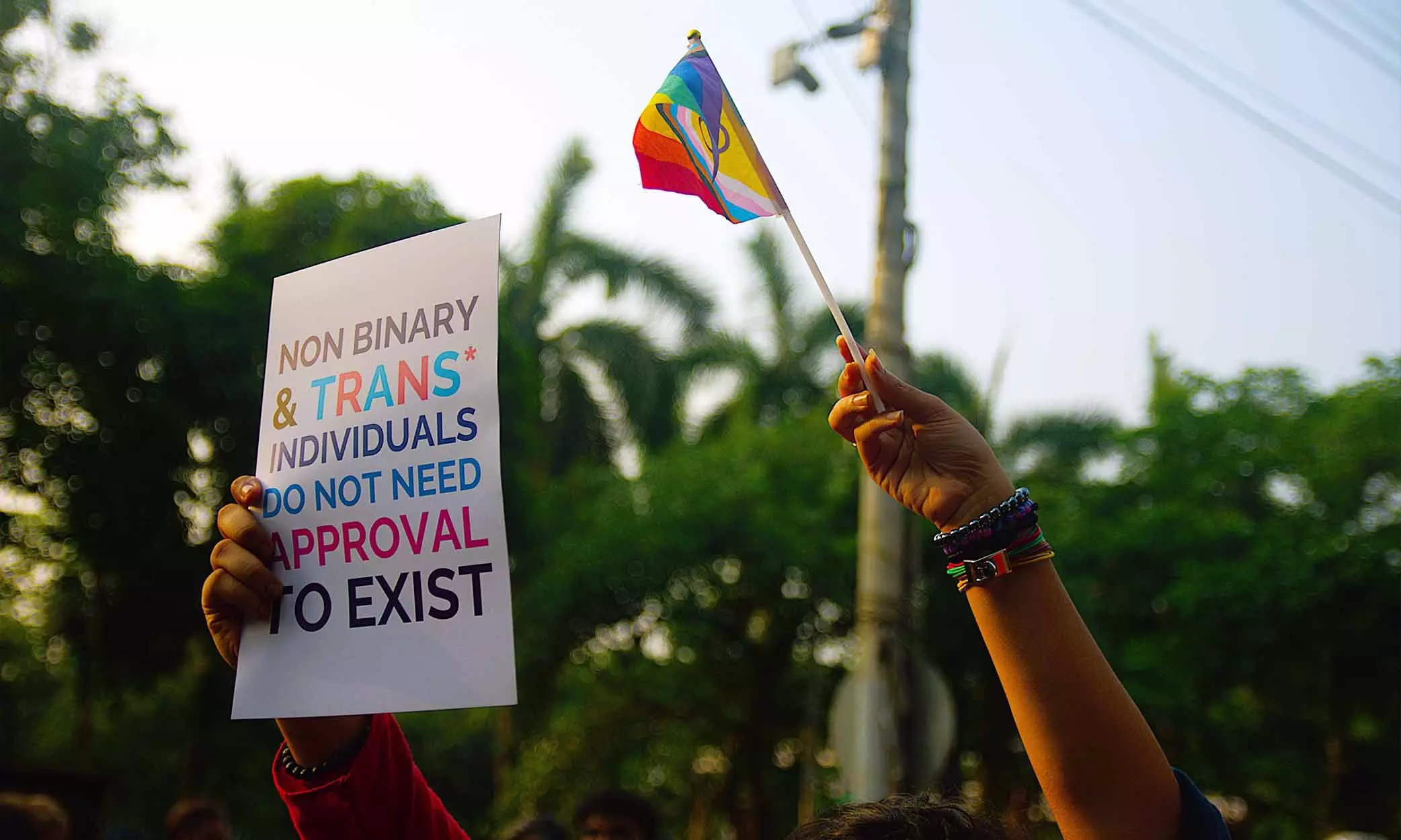
Through on-ground accounts, legal views, and global context, we examine how the line between documentation and intrusion, is shifting as glasses now come with cameras.
In late March, when the queer community and their allies gathered at Jantar Mantar in the capital city of Delhi to oppose changes to India's transgender law, all precautions were taken. Volunteers were posted across the site to discourage unauthorised filming and protect people's identities. Many of those who were in the protest were not out in every part of their lives.
Two months later, Madhav, a Delhi-based student and aspiring writer, was scrolling through Instagram when he stopped on a reel posted on May 26.
It showed his friends at that protest.
The footage moved through the crowd at eye level, slipping between conversations without the telltale jostle of a raised phone. The angles were too natural. No one on the video appeared to know they were being filmed.
The clip, posted by an account that goes by @parley and has more than 318,000 followers, has since crossed 3 million views. In it, the creator moves through the gathering mocking participants, commenting on their appearance and what they were wearing, and prodding them for a reaction.
Madhav felt unsettled.
He called the friends who appeared in the video. None of them had realised they were being recorded. The creator had carried no phone and no visible camera while he spoke to them, only what looked like an ordinary pair of glasses.
"It was only later, after noticing recent reels on his profile where he is seen wearing the same glasses, and that some of those posts were tagged 'Ray-Ban Meta glasses', that they began to connect the dots," Madhav told Decode.
In another video uploaded by the creator on June 11, captioned “2nd POV”, he can be clearly seen wearing the glasses.
“Surveillance in plain sight”
Meta's Ray-Ban smart glasses launched in India in 2025, starting at around Rs 29,900.
A small camera sits embedded near the lens, allowing hands-free recording from the wearer's point of view. Marketed through global campaigns and public figures including Virat Kohli, they are pitched as an everyday lifestyle device for photos, video, livestreams, and talking to Meta AI. A tiny LED switches on while recording, the one signal to bystanders. But, in a crowd, on a device many people don't yet recognise, it is easy to miss.
In a space where participants were already negotiating visibility on their own terms, that gap mattered. "It's surveillance in plain sight," Madhav said.
Wearable cameras don't only record; they change how people act around them.
Cali Schroeder, senior counsel at the Electronic Privacy Information Center, a Washington-based nonprofit that focuses on privacy and civil liberties, said that the technology can potentially “stifle dissent and creativity,” making people afraid to stand out.
“It adds risk for already marginalised groups, ultimately eroding something essential when constant surveillance becomes the norm.”
A Protest Designed for Safety, Breached
The community had strict, community-enforced norms around consent and visibility and, as Madhav put it, "a conscious effort to keep people safe." Being filmed without consent, he said, can have "real consequences."
In the reel, those safeguards fall away.
The creator approaches one protester and asks, "Why are you wearing a saree?" The person tells him sharply to leave. In another exchange, he turns to a police officer and asks what he would do if his son were gay. "I would have broken his bones," the officer replies, an answer that might not have come had the camera been obvious.
By the time Madhav circulated the reel with an SOS asking people to report it, it had already begun to spread.
Harshit, another member of the community, remembered seeing the creator at the protest and recognising him from Instagram, but thinking nothing of it. "He was wearing those glasses, no phone, no mic. It didn't stand out then," he said. "Only later did I make sense of it."
The video was not a one-off. The creator's feed follows a pattern: he walks into public spaces, interrupts strangers, and pushes conversations into uncomfortable territory to capture the reaction.
In one video, he asks a man in a yellow coat whether he had "dived into curry"; in another, he ropes someone into a prank only to throw his cap away mid-conversation. In at least ten recent posts, the camera movement suggests the same glasses were used; some are tagged as filmed on Ray-Ban Meta glasses, and in over half, the creator can be seen wearing them.
Decode reached out to the creator on Instagram. The story will be updated if he responds.
The community had seen versions of this before.
Harshit recalled a Pride parade where a creator named Abhijeet engaged participants in a seemingly neutral way, then later posted a video with demeaning commentary. "We usually welcome people, help them understand, we are warm," he said. "But in the video, he was abusing the community, telling people to 'get testosterone shots'."
That video was eventually taken down after mass reporting on YouTube. At least then, Harshit noted, the camera was a phone.
"This time, people couldn't even tell they were being recorded."
The earlier incident had made people more careful. "This time, people were watching out for anyone barging in with a camera," Harshit said. The glasses made that vigilance almost useless.
The fallout was quick. Clips from the reel have been cut into memes and stickers.
People in the video now worry about being recognised by relatives they are not out to. "One person in the video was already dealing with bullying around their identity," Madhav said. "Now they say people around them are starting to recognise them. They're scared."
Decode also found an imitation reel titled "That one prank video on my feed". The video has over 14 million views, its comments filled with laughing emojis and praise such as "better than original video".
Shabnam, one of the individuals who became the target of ridicule and derogatory comments after the video went viral, posted a reel on June 11. In the video, she says, “For the past two weeks, a video featuring me has gone viral, but nobody has been able to trace any other photo or video of me. You can imagine the effort that has gone into maintaining that privacy.”
“My femininity comes from my maternal lineage. Nobody can dare ask me why I wear a saree,” she added.
Guidelines Without Enforcement
Meta, for its part, says users should respect privacy and follow local laws, offering tips like making it clear when recording and keeping the LED indicator visible. But these safeguards rely entirely on the person wearing the device, with no real way for those being filmed to give or refuse consent.
On the legal side, Advocate Alvin Antony said India lacks a single comprehensive law on non-consensual recording, with the issue instead governed by a patchwork balancing free speech under Article 19 and privacy under Article 21.
“Here, that line matters, especially if the footage targets transgender people or harms identifiable individuals, potentially attracting defamation under Section 356 or promoting enmity under Section 196 of the BNS,” he explained.
The Transgender Persons (Protection of Rights) Act, also offers safeguards, with Antony noting that non-consensual filming can amount to forced outing, raising dignity concerns under principles from the NALSA judgment.
The question of data protection adds another layer. AI features are switched on by default, and footage is processed within Meta’s systems. “The bystander’s image effectively becomes training data, without any lawful basis,” he said, pointing to concerns around purpose limitation under the DPDP Act, 2023.
Additionally, the voice data may be stored for up to a year, raising questions around storage limitation and erasure obligations under the data protection Act. “There is no opt-out for them at all,” he said.
Taken together, he said, the system “maximises capture and minimises liability,” placing most of the burden on the individual user.
“While Indian law has sections under the BNS, DPDP Act and IT Act, that touch on these issues, gaps remain—especially for emerging technologies like smart glasses, where clear consent and enforcement rules are lacking.”
The same logic extends to where the video travelled. The device that recorded the protest and the platform that carried it to millions belong to the same company.
Despite tagging the police and reporting the video to Instagram, Madhav has seen no action till date. Using his verified account, he reached Instagram's support team directly and was told the video would be reviewed; within 24 hours, the platform replied that it did not violate its guidelines.
Instagram's rules allow it to remove content that targets people with degrading or abusive language, especially where it amounts to harassment. But enforcement turns on how intent and harm are read, and that line is hard to draw. The device that captured the footage, the platform that spread it, and the company that declined to act are all parts of the same system.
Platforms cannot hold themselves apart from the harms their tools enable, Schroeder argued. Given the known risks, she said, Meta has failed to build adequate safeguards: "As a result, the harms are already occurring and likely to grow with wider adoption." Accountability, she added, should go beyond fines.
Decode has reached out to Meta for a comment. The story will be updated if they respond.
Beyond One Protest
What happened at Jantar Mantar fits a wider record. Meta's AI glasses have drawn scrutiny worldwide over how they capture, process, and move data, often invisibly to the people being recorded.
In the United States, there has already been reporting on law enforcement agencies, like ICE, using Meta AI glasses to record and identify people in public spaces.
Investigations have also pointed to what happens after the recording. A Swedish media report found that footage from the glasses was being reviewed by workers in Kenya to train AI systems, some of it intimate or sensitive, far from what users likely pictured when they hit record.
These disclosures have prompted lawsuits in the US. In one, plaintiffs argue that Meta marketed the glasses as “privacy-first” without adequately disclosing that audio and video could be stored, transmitted, and accessed by human reviewers. Others argue that bystanders, who never agreed to be filmed, had no meaningful way to consent.
Schroeder pointed to internal documents suggesting Meta timed the rollout of facial recognition features in the glasses to avoid scrutiny. “That tells you they are aware of the risks and are still choosing to move ahead anyway” she said.
The costs, she added, are unevenly distributed. “The people who are already watched the most—immigrants, protestors, dissidents—are the ones who will feel this first,” she said. “For them, this isn’t a hypothetical risk. It’s an escalation.”
Existing legal protections, she said, are being outpaced.
“The laws cannot turn hollow just because the camera is now on a pair of glasses.”
What is needed, she said, is not just new regulation, but enforcement with consent, notice, and reasonable expectations treated as non-negotiable.
Back at the protest, those concerns were no longer abstract. The reel had already moved far beyond the moment it captured, leaving recognition, ridicule, and the fear of being seen by the wrong person, all from a recording no one agreed to.
“These incidents will only increase. We can’t realistically stop people from entering protests. We had guidelines and volunteers in place, but this still came out of nowhere,” Harshit said.
Meta confirmed removing the video from Instagram on June 18, saying it "violated their Community Standards".