
Under Lathis And A Locked-Down City: A Reporter's Diary From The July 20 Sansad March
Thousands gathered at Jantar Mantar to march on Parliament. By evening, the march was scattered, the road to Sansad still barricaded, and strangers were the only ones holding anyone together.

6 AM. Central Delhi is already sealed. Five metro stations — Rajiv Chowk, Janpath, Patel Chowk, Central Secretariat, Seva Teerth — are shutting on and off through the morning, commuters turned back or made to exit early. Section 163 of the Bharatiya Nyaya Sanhita is in force, the modern version of the old Section 144, and it shows: layered barricades down every road that leads toward Parliament, hundreds of police pulled in from other districts, CRPF and RAF behind them. Mobile internet slows to nothing in patches. It is hard to find people. It is hard to be found.
None of this seems to surprise the people arriving. A group of farmers from Pilibhit tell me they left at 11 pm the night before to make it here by dawn. "We are here to support the future of this country," one of them says.
Students are walking long stretches from stations that shut before they could get off, cutting through checkpoints on foot.
Farmers from Pilibhit, UP reached Jantar Mantar to support the movement
9 AM. This was the scheduled start time. Jantar Mantar is already full. Police are restricting entry even as more people keep arriving outside, unsure where to stand, waiting for a door that isn't opening.
Inside the barricades, it still feels almost like a festival — flags, someone playing music, placards still being painted. Outside, the mood is thinning fast. People cluster at different points along Tolstoy Marg, Central Park, Connaught Place, Raisina Road, unsure where the march will actually begin.
This is where the day starts coming apart. Not from any one order, but from the gap between what the march was supposed to be — one body moving toward Parliament — and what it becomes once the venue can't hold everyone who showed up for it: several marches, each with its own edge of the crowd, each unaware of what's happening to the others.
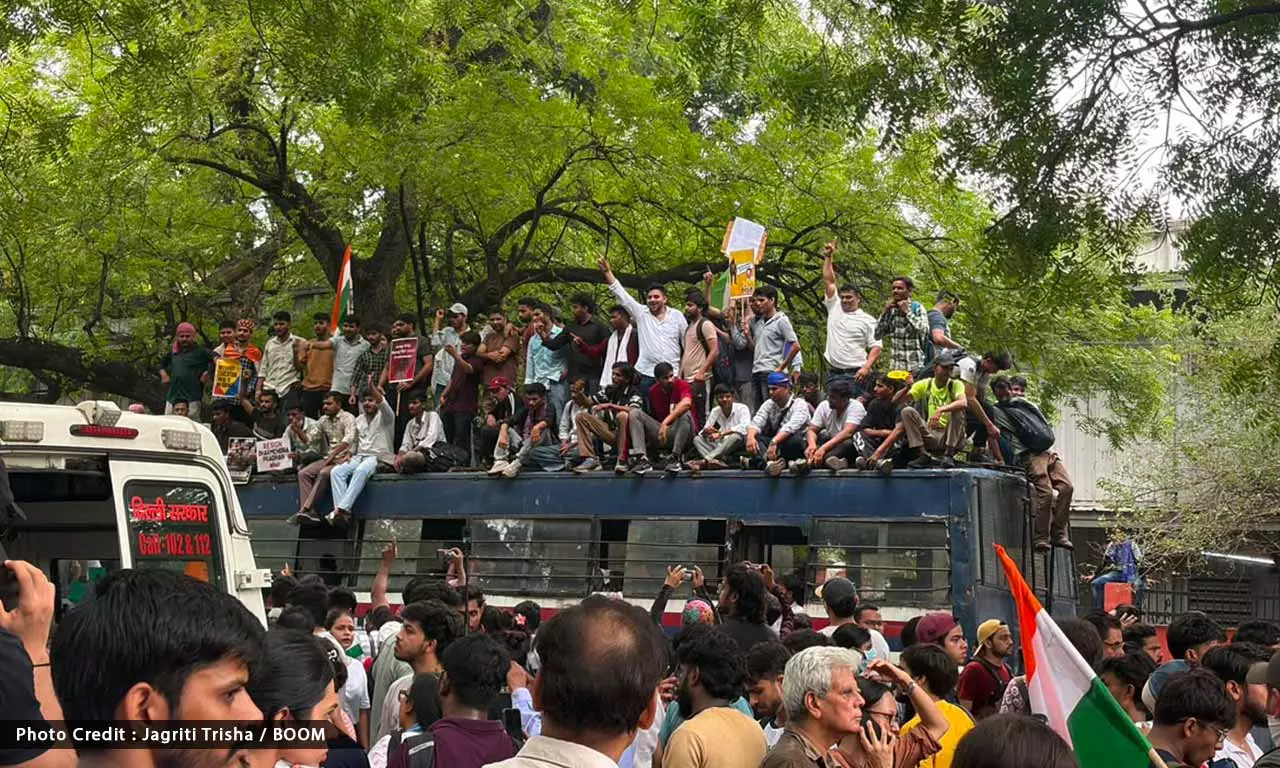
The streets around Jantar Mantar swarmed with people as the day progressed
Noon. The march finally begins, almost three hours late, led by Cockroach Janta Party founder Abhijeet Dipke from a mini-truck rigged with loudspeakers. He's holding a pocket Constitution in one hand, a mic in the other. He doesn't get past the first barricade.
By now the crowd isn't one crowd anymore. Some groups start walking from the outer roads after failing to get into Jantar Mantar at all. Others are still inside, still painting placards, with no idea a march is already underway somewhere else in the same square mile.
Early afternoon. The first confrontation happens around the periphery of the Jantar Mantar, while the main protest site is still calm. Tear gas shells come off a mounted vehicle in quick bursts. People scatter, regroup, scatter again. Lathi charges follow wherever a group tries to push past a barricade or just find its way back to itself.
Some of the police in the crackdown are in plain clothes, without nameplates. I don't get a straight answer from anyone about who they are.
A student I meet later, inside the protest site, is still shaking. "I was running when people started falling," she tells me. "At least ten people fell on top of me. I couldn't move. I thought I would suffocate." Her toenail is broken; someone pulled her out of the pile. She doesn't know who.
A protester from Rohini describes getting caught in multiple rounds of baton charges with no warning, no announced route. "We didn't know where to go. There was no clear route, no announcements. People were just trying to get away." He is an SSC aspirant. "We are fed up with paper leaks and subsequent exam cancellations. When we seek an answer, this is not how we expect to be treated."
A UPSC aspirant from Bihar says he was struck in the chest. "I had gone numb for at least a minute after they hit me. Police are treating us like we are not humans, forget being fellow citizens."
Central Delhi saw heavy deployment of RAF and CRPF, along with the Delhi Police
Somewhere in the middle of all this, a negotiation is happening that almost nobody on the street knows about. CJP spokesperson Saurav Das posts on X that he and Ashutosh Ranka are headed to meet Union Health Minister JP Nadda — the government had reached out for talks that morning, after weeks of silence through the sit-in. The demands: Sonam Wangchuk's release, Education Minister Dharmendra Pradhan's resignation, Rs 1 crore compensation for the families of NEET aspirants who died by suicide.
The meeting goes nowhere. No commitments, just an assurance that the demands will be "discussed at the appropriate level". The CJP spokespersons later say the four hours were wasted.
Dipke announces the outreach briefly from the truck, but his voice doesn't carry past the people standing close to him. With the internet crawling and the crowd spread across several roads at once, the news moves in fragments — if it moves at all. A protester still catching his breath after a lathi charge tells me: "There was no communication from anyone about what was happening inside Jantar Mantar. We were outside, just preparing for the march, because that's what we had come for."
By the time word does spread, the streets have already gone from protest to dispersal.
The protesters started marching towards Parliament from Jantar Mantar
Evening. The march, as a march, is over. People are scattered across Janpath, Tolstoy Marg, and the roads around them, metro stations still shut, routes still sealed. What holds the day together after this point isn't any organiser or any announcement. It's water passed hand to hand. Strangers checking on the injured. People walking each other back through roads they don't recognise, because the ones they came in on are blocked. Borrowed phones, because so many networks have gone down.
Inside Parliament, the Monsoon Session opens with the usual language about "constructive dialogue." A few kilometres away, the march that was supposed to reach its gates hasn't got within sight of them.
Strangers held space for one another, relying on each other’s goodwill
The next morning, Dipke posts an apology on X. "I apologise to all our supporters, especially the girls who were brutally beaten… We could have done better," he writes, and says the movement isn't stopping. At Jantar Mantar, it hasn't. The stage is damaged, the lighting is down to whatever's left, but people are back — fewer of them, holding the same ground thousands stood on a day earlier, waiting for the same three demands to be met.
What I keep coming back to isn't the tear gas or the barricades. It's how many of yesterday's protesters I never actually saw protest — I saw them looking for each other. And mostly finding each other, in the end, without any help from the people whose job it was to help them.