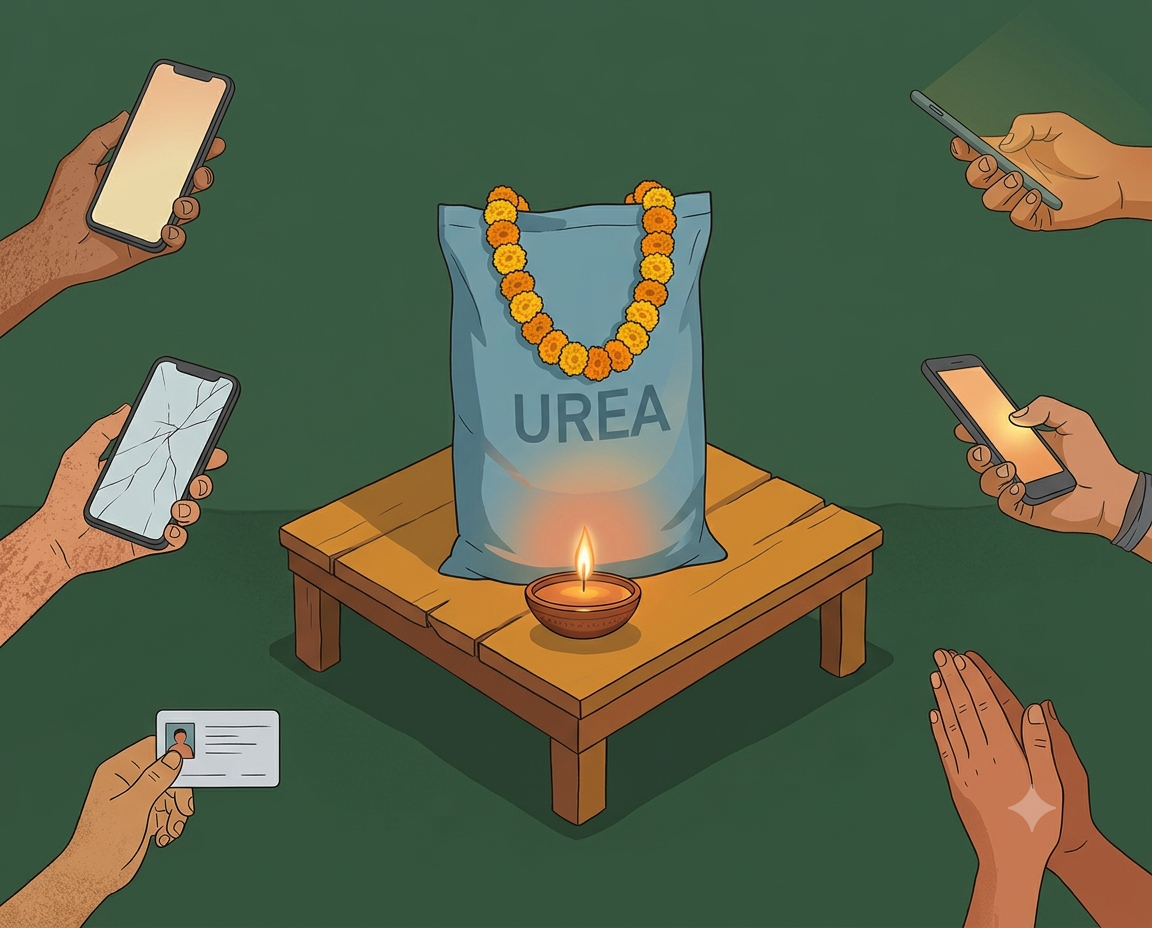
The Social Life of Urea: What Farmers’ Reels Tell Us About India's Agrarian Crisis
On Instagram and YouTube, urea is not an agricultural input. It is gold, a weapon, a love interest, a deity. A subculture of farmer content reveals what policy discussions miss.

A recent Decode investigation documented the crisis behind these reels. A new digital identity system, the Farmer ID, tied to land records that millions of cultivators don't appear in, has become a gate between farmers and the fertiliser their crops need, even as urea sits unsold in warehouses. That story traced the policy. This analysis piece looks at the culture — what the reels themselves tell us about how farmers experience, perform, and resist the scarcity that the system has created.
"Aaj mere paas paisa hai, bangla hai, gaadi hai, naukar hai, bank balance hai... aur tumhare paas kya hai?"
"Mere paas 26 katta urea hai."
The Deewar dialogue, Bollywood's most famous confrontation between two brothers, has found a new life on India’s rural Instagram feed. Money, bungalow, car, bank balance on one side. Twenty-six bags of urea on the other. The farmer wins.
This reel is one of thousands. Across Instagram and YouTube, in Hindi, Bhojpuri, Telugu, Awadhi and Punjabi, farmers are making content about urea — memes, songs, skits, political critiques, worship videos. The formats vary. The recurring pattern does not: urea almost never appears as a neutral agricultural input. It is a cultural object through which farmers negotiate aspiration, power, politics, belonging, and sometimes love.
Most conversations about chemical fertiliser use stay within two groups — activists and scientists pushing for reduction on one side, and alternative farming practitioners on the other. Their concerns are about ecology, climate, soil health. The economics get discussed too: subsidies, import dependence, the cost of transition. But a massive segment of the farming community and its voice is missing from both conversations. What do farmers themselves say about urea — not in surveys, not in policy consultations, but in the content they make for each other?
This part of the internet is largely unindexed. Finding it requires understanding regional slang, deliberate misspellings, local metaphors and keywords that no search algorithm surfaces on its own.
What I found, across languages and formats, falls into a few patterns.
Urea, wealth, and masculine pride
Farmers call urea safed sona: white gold. The content around it borrows heavily from cinema. The Deewar rework is one version. Pushpa 2 gets the same treatment: "1 ton ka dhaaee crore?! Kya mazaak kar rahe ho Pushpa!"
A joke about the difficulty of acquiring urea is now framed in the language of a drug deal.
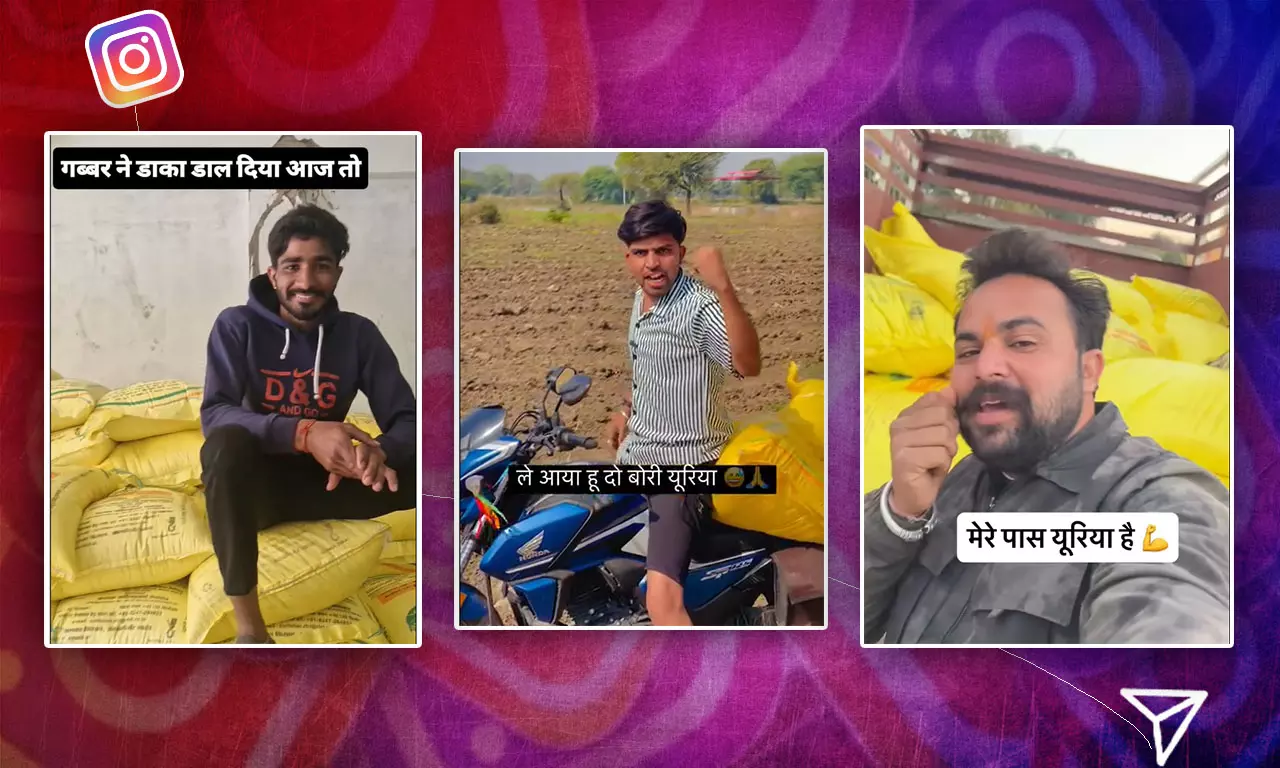
The visuals match the tone. Sacks stacked in godowns, truck unloadings, farmers posing with large quantities of fertiliser, staged as displays of abundance. "Humne daaka daal dia” (we pulled off a heist). "Hoga powerful, yahan toh ek hee admi powerful hai" (the man sitting on the fertiliser bags is the one in power).
The joke works because the audience collectively understands urea as scarce, valuable, and worth performing around. And it holds two truths at once: farmers who queue for hours for a single bag, and the same farmers, on screen, staging abundance and control.
Patriarchy is in the mix too. A large share of urea reels use fertiliser as a prop for romantic one-upmanship and masculine assertion.
"Thukraake mere pyaar, mera intekhaam dekhegi… “ (You rejected me, so I got urea from your dad) is posed as the ultimate revenge in one reel.
In these reels, urea replaces the motorcycle, the gold chain, the car — the objects through which rural masculinity has traditionally been performed on screen. That the replacement is a bag of fertiliser says something about what scarcity has made valuable.
Political assertion through memes
A third stream of content is explicitly political. These reels and posts spike around government announcements on subsidies, shortages, price hikes and black-market crackdowns. They contrast official claims with lived reality, often sharply.
While farmer commentary on larger agrarian distress has existed for very long, on issues of water, land, floods, droughts, seeds; but issues emerging from modern bureaucratic systems are a new genre.
"Yeh sarkaar hamesha headline mein, aur humare desh ka kisaan urea ki line mein." (The government is always in the headlines; the country's farmer is always in the urea queue.)
"On Instagram we see godowns of urea. In reality nothing is available. One day you will also see crops growing only on Instagram."
"Acche days have arrived: crop insurance 613 rupees, no DAP, no urea, no price in the mandi."
These lyrics are made by rural and small-town artists — Bhojpuri folk singers like Ashish Deva, Poonam Kushwaha and Sujit Lal Yadav; Telugu political folk composers like Manukota Prasad and Maddela Sandeep; Awadhi kahrawa artists like Sagar Sargam; Punjabi farm-song veterans like Varinder Khaira. Their songs and skits are personal, but they function as political rallying calls — individual frustration made collectively expressible.
These artists are largely rural and small-town artists, they run labels from their districts, and their reach runs in a few lakhs. Their response is quick, packaged with dance videos, pre-formatted for reels, and sometimes studio recordings.
Ashish Deva, one of the singer- songwriter, who last year, produced “Nahi Mile Urea Khad", does a range of genres - devotional music, festive folk tracks and socially relevant rural storytelling. His music is released under a rural music record “SP Music World”, that operates from Uttar Pradesh and Bihar (specifically the Awadh and Purvanchal regions). Produced in these regional studios, between banter, folk tales, relatable and rural subjects, the songs on urea, run across millions of views on all channels.
These artists have a pulse on the crises, language and emotion to describe it. Their music travels faster than any announcements, media pieces, because of their location (physical, social and cultural).
What’s unique is their very strong sense of turning private humiliation, a policy crisis of not receiving an OTP, standing in a queue overnight, dealing with shortages, at a point in time in the year into viral, emotive, resonant pieces.
Why this matters now
This Kharif season, the Indian government introduced the Farmer ID, a digital identity linked to land records that is increasingly becoming mandatory to access subsidised fertiliser, crop insurance, loan waivers and PM-KISAN payments. Millions of tenant farmers, sharecroppers and women cultivators who don't hold land titles were locked out. Urea sat in warehouses in surplus while farmers couldn't access a bag. The reels spiked again.
With a major roll out of Kisan ID that offers a multitude of benefits. Urea, and its known supply challenges, has meant that this time, the reels offer very strong political satire and commentary, it’s around four words: OTP, token/ ID, line and love. This encompasses India’s digital churn in the last 10 years, it’s a story that repeats itself, of quick digitisation processes, access of or denial of services, burden of proof of identity, and finding moments of joy and laughter in this.
The situation is evolving and all commentary is surrounding these topics. In the center of it is the farmer, who has to somehow book a token, access the OTP, stand in a queue, and also find time to make other key decisions and choices.
Mainstream media has largely told the farmer's story in two registers: the helpless victim or the angry protester. The urea subculture doesn't fit either frame. Here, farmers are performers, satirists, political commentators, musicians — people with agency, using the platforms available to them to say what official channels don't capture.
The failure to understand this subculture has consequences.
When the songs and memes and reels start peaking, a crisis is already deep inside the village. This content is real-time social signalling. It is faster than any survey, more granular than any government dashboard.
This is offering a very key signal, and that is, urea is no longer a basic agricultural input, it is an emotional lifeline, a psychological necessity. This micro-genre, while highlighting the crises that it should do, is also reinforcing, holding the status quo, and producing certain norms, customs and beliefs. If we miss seeing them, engaging with these studios, we continue to talk in a language that doesn’t belong and doesn’t translate.
For anyone trying to understand what is actually happening in rural India, the micro-genre is data.
In a workshop in Bihar, farmers talked about how they are perceived, talked about and highlighted by media, government and market players. It all resolved to farmers being seen as passive "recipients" of benefits, sale of products, a post-celebrity moment, but every day ness of negotiating, living, and thinking is missing, and through this agency and voice, they challenge, come on new platforms and find their voice.
The insights have been gathered continuously through social listening and sense-making, on-ground workshops and field truthing across digital and offline spaces, convened by Hands of Transition and it’s partners.