Blurred Answers, Closed Window: CBSE's Digital Overhaul Failed Its Students
The board launched a new digital marking system with no pilot. When it broke, nearly 4 lakh students found little help for recourse.

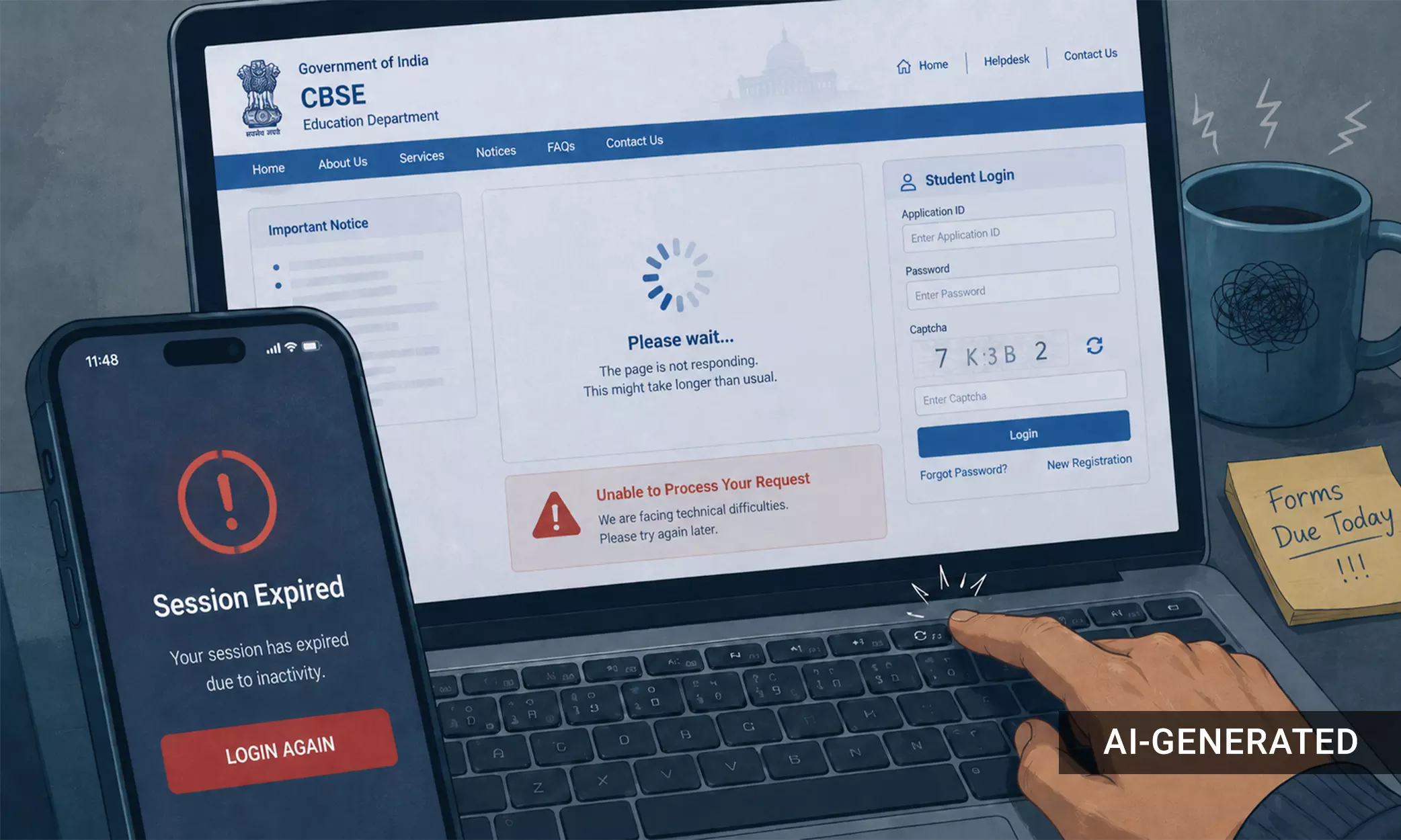
Harsh spent three days trying to log in. Every time the 17-year-old filled in his Aadhaar details, date of birth, captcha, the CBSE portal crashed. "Everything kept showing invalid. The site kept crashing," he told Decode. "I thought of giving up so many times."
By the time he got through, one answer sheet finally arrived. It was completely blurred, yet marked. "How could I have applied for either of the processes, if I don't understand a word on it?" he asked. He wrote to CBSE asking for a clear version. No response came. The second sheet he had requested never arrived.
By June 7, when the window to appeal his marks shut, Harsh had lost his only chance to challenge scores he was convinced were unfair.
He had scored 47 in Accountancy and 55 in Business Studies. He was expecting at least 70 in both.
Harsh was among the four lakh students who tried to access their answer sheets through CBSE's new On-Screen Marking system between mid-May and early June.
The System That Never Got Tested
The trouble did not start with the results. It traces back to how the OSM system was introduced.
Reportedly, the board members had recommended piloting the system across subjects and regions before scaling it. Those pilots never happened.
Instead, what followed was a limited, two-day exercise in January 2026 involving around 100 teachers from five Delhi schools. Teachers who participated urged the board to delay the rollout, flagging missing features and the need for more preparation time. The board did not listen.
CBSE announced the rollout on February 9, just days before Class 12 exams began on February 17. Evaluation under the new system started on March 7. By the time results were declared on May 13 and the re-evaluation window opened on May 19, the system began to break in real time.
The problems were not limited to students. A Jharkhand-based teacher, speaking to Decode on condition of anonymity, said the process was far more time-consuming than expected. “We were getting blurred pages, and sometimes pages were missing in between. It becomes very difficult to assign marks if the copies are not scanned properly,” she said.
The teacher said she was assigned 18–20 answer sheets, with six hours to complete the evaluation. Training, she added, was minimal, limited to evaluating only five sample answer sheets for practice beforehand.
The damage was immediate and widespread. Students across cities reported missing supplementary sheets, mismatched copies, incorrect marking, and blurred scans. By late May, they had turned to X and Instagram to share what they were experiencing, flooding the platforms with screenshots of failed logins, incomplete answer sheets, and blank pages marked as correct.
Irfan, a student from West Bengal, posted a video of his Chemistry paper that has since crossed 26,000 views. Several pages of the answer sheet were left unchecked and marks appeared to be awarded arbitrarily, even on blank pages.
"After cross-checking every answer, I realised I should have got at least 20 marks more," he said.
Getting to that point cost him weeks of frustration. "I was trying from the first day. By May 23, I had managed to get halfway through the application, but my payment went through only a few hours before the window closed on May 25. I almost gave up many times."
Irfan eventually turned to social media too. “Everyone else was posting, so I did too, just to add to the noise,” he said. “At the very least, the re-evaluation process would be executed efficiently, if pressure persisted.”
Every Step Cost Money, And Failed
Unlike Harsh, Vasanth from Gorakhpur was able to access his answer sheets and apply for re-evaluation before the window shut. But the sheets were blurred in parts, marks appeared wrongly deducted, and he has no idea how some answers were even evaluated.
“I don’t even know how it was possible to evaluate the blurred parts,” he said.
Vasanth was expecting at least a 60 in Mathematics, but it didn’t even reach the passing mark.
That number matters. Vasanth wants to take a drop year and prepare for IIT entrances, where a minimum of 75 percent in Class 12 is required.
His parents watched him refresh the portal for days before asking him to move on and focus on the compartment exam in July. He refused to back down. “I don’t want to give up. I know I deserve more. How can I get half a mark in an MCQ?” he said.
What made it worse was the cost. CBSE charges Rs 100 per answer sheet, Rs 100 per paper for verification, and Rs 25 per question for re-evaluation. Vasanth applied for re-evaluation of 13 questions. It cost him Rs 425 so far, for marks he is not confident he will get back.
For Divij Sharma, a Delhi student, the cost spiralled. He applied for answer sheet copies across five subjects, but as the site crashed, he tried accessing it on three devices simultaneously. The payment went through on all three. The total: Rs 1,500. He has not received a refund.
When the sheets finally arrived, Divij decided not to pursue re-evaluation.
"The marks might have gone up marginally, but it wasn't worth the frustration or the additional cost," he said.
Akshi, also from Delhi, expected to score in the 80s in English but landed in the 70s. She began applying for her answer sheet, but soon gave up.
"It felt like a rabbit hole. The site crashes, clicks don't work, my payment gets stuck repeatedly. I waited four days just to apply," she said. When the sheet arrived, it was incomplete. The process of appealing felt impossible.
"I was too frustrated to continue and go through the same glitches again."
Compression At The Cost Of Access
Before OSM, the process of verification and re-evaluation followed a more staggered timeline. Access to answer sheets, verification of marks, and re-evaluation applications each had clear gaps between them, giving students time to plan and act.
With OSM, that gap compressed. Access, clarity, and timing all needed to align at once. The system was supposed to speed things up. Instead, it made the window narrower, the pressure higher, and the room for error—technical or otherwise—much larger.
By the time a usable answer sheet could arrive, the re-evaluation window was often already closing, or the technical glitches that had slowed access were still active. Many students were effectively locked out of the appeal process before it started.
Nearly 1.6 lakh students managed to submit re-evaluation requests out of the 3.9 lakh who had accessed their sheets by May 25. That number excludes students like Harsh and Akshi, who say they were denied a fair chance to even contest their marks.
X became the space where students shared complaints (real posts compiled using AI).
Harsh plans to pursue a Bachelor of Business Administration (BBA) degree, and his board marks may not directly determine his admission, which will hinge on his Common University Entrance Test (CUET) score. But for him, that is beside the point. “I didn’t even get a fair chance to appeal. The digital process was supposed to make things easier, not shut doors,” he said.
What lingers is not just the score, but what it represents. “It is embarrassing. I have the lowest marks in my friend circle.”
No Recourse, No Extension
As students missed the narrow window, they turned to social media demanding an extension. The Delhi High Court declined to grant one, hearing a petition filed by a student body. The bench said that allowing a reopening would delay the overall result process, and that aggrieved students were free to pursue remedies on their own.
That leaves teenagers navigating legal remedies individually. Supreme Court Advocate-on-Record Mamta Sharma said students can approach the High Court under Article 226 in cases involving denial of fair opportunity. "Authorities rarely relax deadlines unless directed by a court," she said. "When technical failures block access to available remedies, timely legal intervention may be necessary to protect a student's academic future."
For a typical 17-year-old, that is not a realistic path.
As re-evaluation results began arriving, the frustration has not really gone away.
Simardeep, a Delhi student, applied for re-evaluation in Maths and English, expecting around 15 marks to be corrected in each. He got five more in both.
"It feels like putting in so much time and frustration for nothing," he said. "The process shouldn't have been this tiring at least."
The irony lingers. CBSE introduced OSM to make the system fairer, faster, and more transparent. What students experienced was the opposite: a system that locked them out, moved faster than they could follow, and broke when they needed it most.
“The process sounds good on paper. The digital copies are less prone to damage or spillage. OSM even provided a better step-marking process. But none of that matters if it is not executed well,” said Akshi.
CBSE has not responded to specific queries by Decode at the time of publication. The story will be updated when they do.